I do believe I am a little museum junkie. To me, museums are a visual and reflective experience, with every artifact transporting me across time and space. Words cannot explain the connection I feel with the millennia of humankind that I feel through one tiny fragment, almost as though I were a time traveler.
I try and visit one in every new place I go to, including one at Andaman and Nicobar. That one was a bit sad though… we have no sense of managing museums in India. Everything becomes a room full of stuffed dusty animals, wax replicas of humans, unloved displays and no sense of the immense potential of museums. To think of it, even the towns where I live in currently have no museums. We do have a museum of the Black Cat Commandoes though…ahem.
Anyway, when I was in Germany, I made sure I bought a Museum Pass. Suffice it to say- the more museums you can visit with this multi-day pass, the more paisa-vasool it can be. However, here’s what you could end up with…very sore feet. Also, I think I could have spiced up the nights with a bit of partying…which I am sorry to say I did not do much of. {How sad is that! Now look at us..41 years old this July, locked up in a post-pandemic world, creaky bones.. life should be full of museums, adventures, parties, trysts 🙂 }
Berlin has five interesting museums in what they call the Museuminsel (Museum Island)- the Pergamon Museum, the Neues Museum and the Bode/ Altis Museum. There’s also the Deutsche Historical Museum but I think this was across the river.
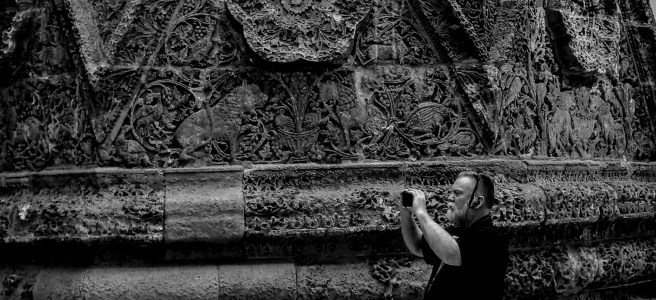
Here I bring you just a small sample of the wonders at the Pergamon, a name that by itself conjures up early twentieth century images of excavations (yes, yes, exactly what you can imagine- colonial white sahibs and us natives that fill the background with our little hammers going plink-plink-plink in the dusty sun. Reminds me of Agatha Christie too hmmm. Then afterwards, just before the sun sets, a little “cobalt-blue” shrapnel emerges from the dust, and it is the just the beginning of the walled city of Nebuchednezzar…).
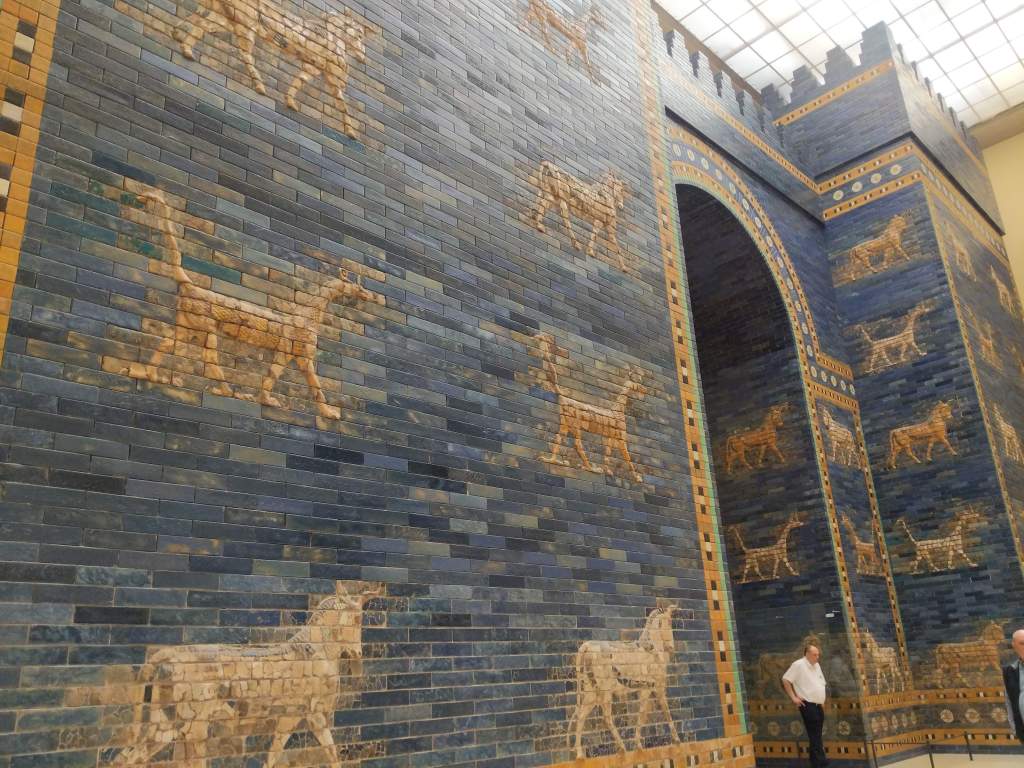
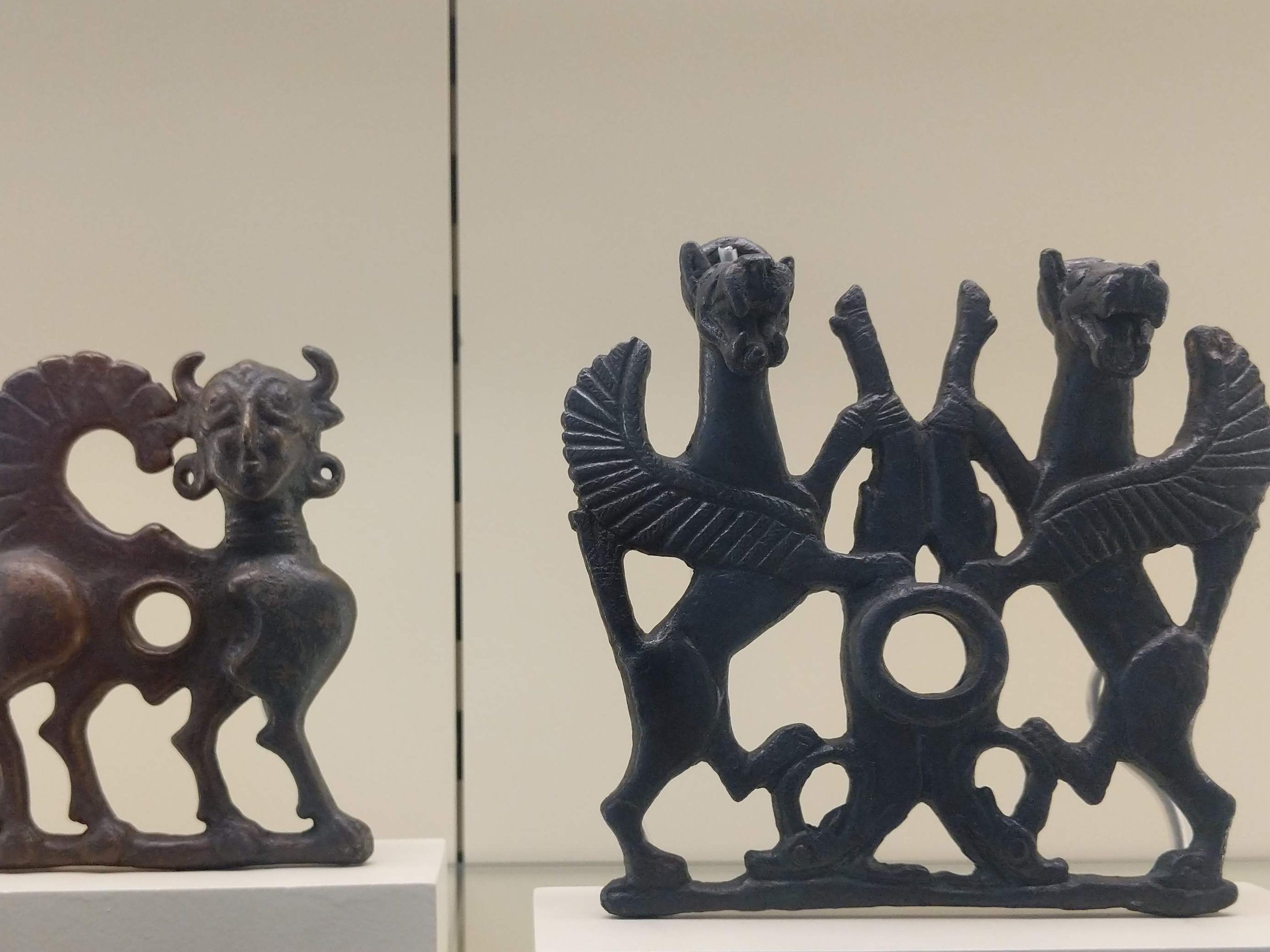
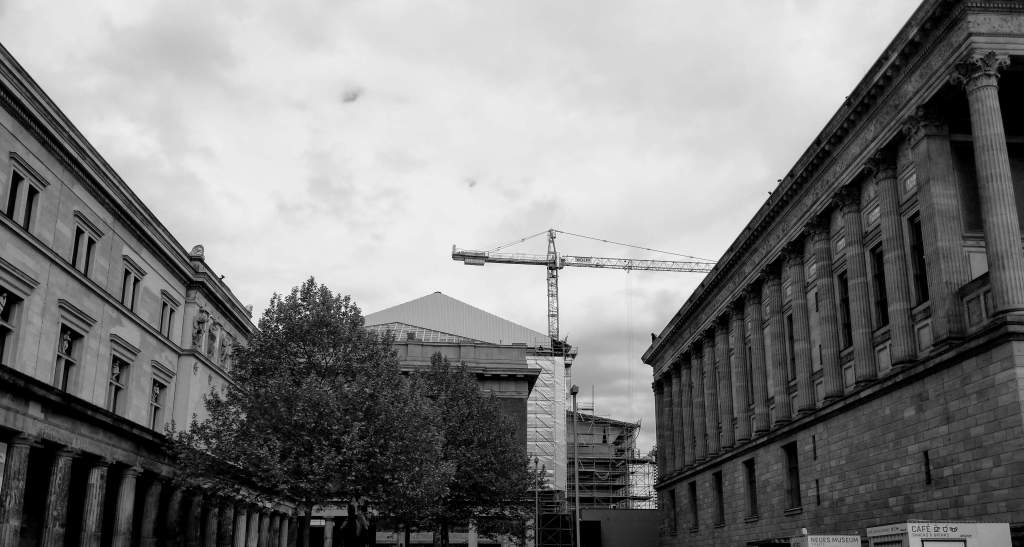
The Pergemon Museum has the absolutely majestic, and royal blue Gates of Ishtar. Humanity has to be admired for some of its greatest creations, including this beauty from 6th century B.C.E Babylon (modern day Iraq). Read more about these here on BBC CultureI am fascinated by these little figurines. It reminds me of The Exorcist, and this movie has another one of those colonial era digs in the opening scene too. :”)When I visited in May 2019, there was some work getting done at Pergamon which meant some sections were shut. Some things we are not meant to see I suppose.
If I continue to post on Europe I will never get to other beautiful places, so here is a post on Darjeeling. This is a town where I grew up in, and its quietly beautiful and crumbling colonial architecture has always reminded me of the fall of hubris.
The town was built in the mid-nineteenth century by the British as a sanatorium for invalid soldiers. The first 100 years of its existence were its halcyon days. Planter’s clubs for the tea-garden managers, the mall-road, bookstores, colleges, churches, railway stations(!), bakeries, water reservoirs that brought piped water into cosy bungalows with gardens of rhododendrons, chrysanthemums ….you get the idea.
Everything about Darjeeling was privilege, with the colonials living on hill tops and the “natives” down below the chawk in early industrial era housing colonies- Butcher-basti, Ghadi-khan, Gurung-basti, Balwa-khana.
Fast forward another hundred and seventy years, the town is crumbling under massive population migrations, commercial exploitation through the tourism industry and yet..oh my god, and yet some old vestiges still shine through.
.
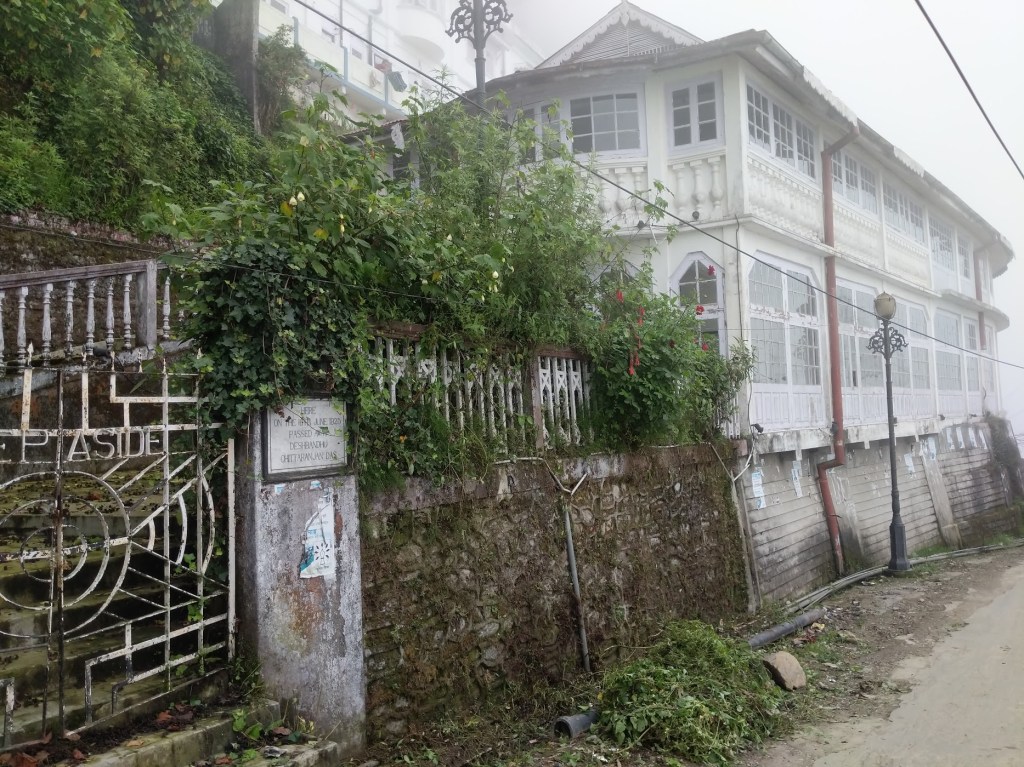
>> the house that where deshbandhu Chittaranjan Das passed away in 1925.<<
In many ways, Darjeeling is like Old Delhi, or parts of South Mumbai or Kolkata, Chennai, Mysore..everywhere where you see crumbling ruins of past glory taken over by incessant ant-like humanity. Anywhere else in the world these little nooks and corners would be cherished as part of a historical legacy, but in India everything gets tossed out. Out with the old, in with the new. I especially think its also because typically with a regime-change, the original urbanised population gets massively dislocated, or lose power. A new people, themselves dislocated from rural areas because of systemic failure, move in. This is a new people, we do not care about who was here before. It’s a daily rise and fall of the Roman Empire in the streets of old Indian cities and towns. And so it goes until everything is dust.
That fascinates me, this impermanence of things. Of beauty, grandeur. In a way, this is the east’s way of saying- nothing that man builds will last.
Hopefully what will last will be the mist. or will it? I cannot say. That is why I am taking pictures to capture the mist and the greenery. This is how beautiful it is even now. Like an old old impoverished courtesan. So that you can imagine how gloriously beautiful she was in her youth.
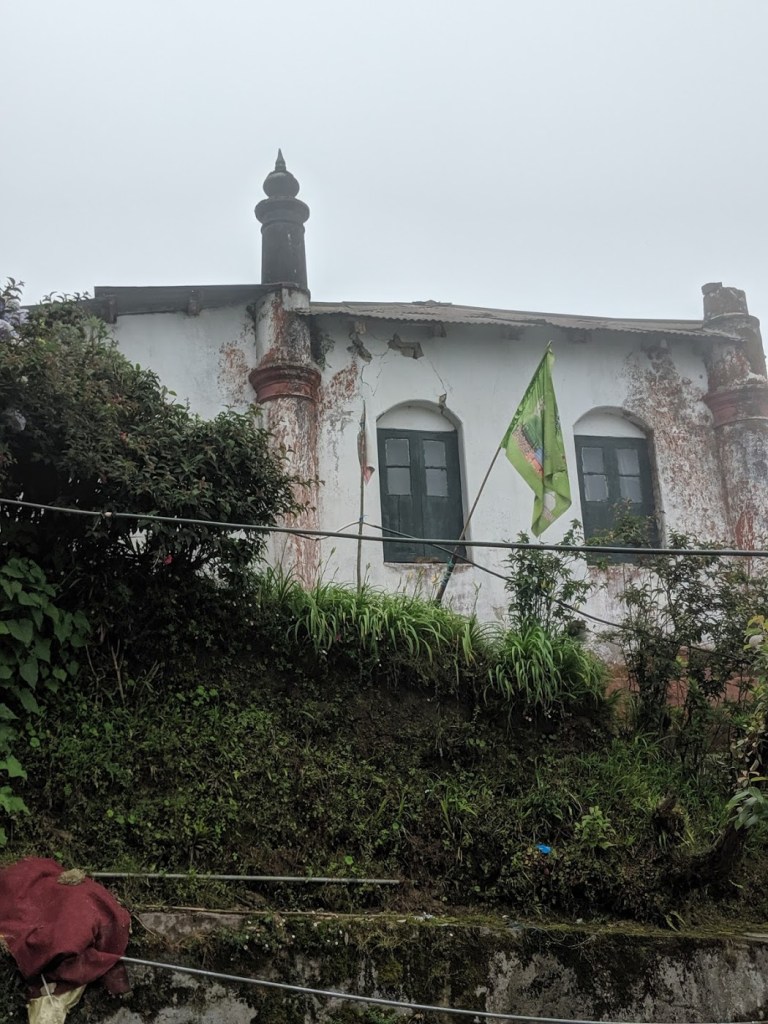
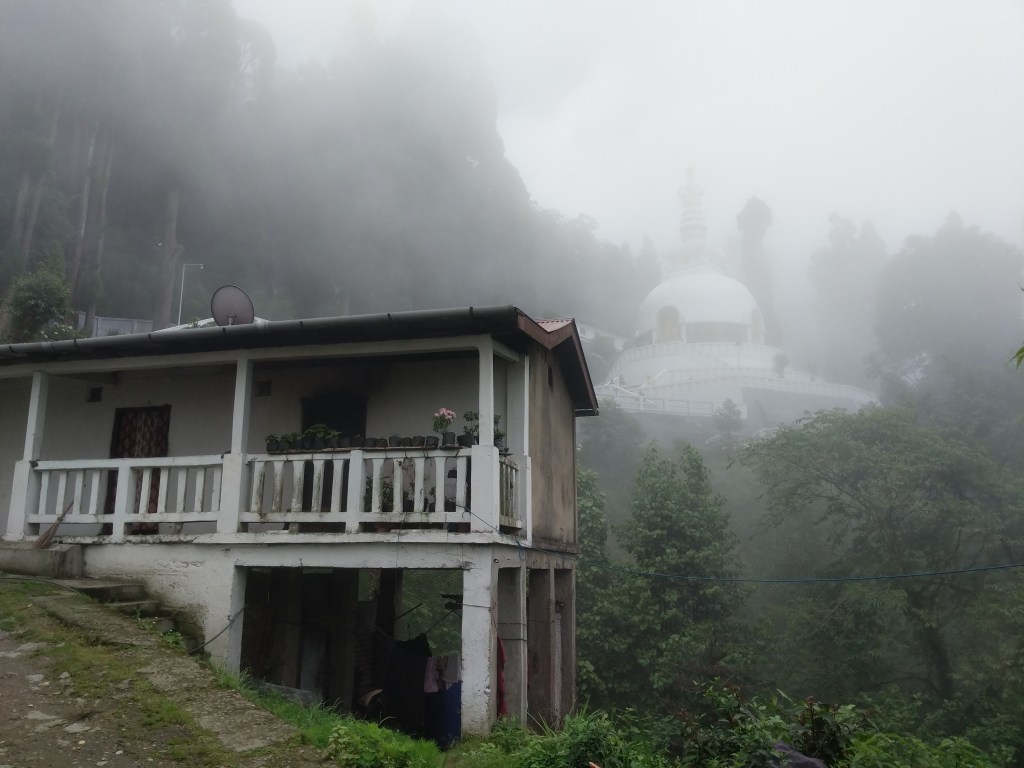
>> probably one of the old examples of a mosque in the hill town, somewhere along Jalapahar<<>> not colonial era, but beautifully quiet. The area around Japanese Temple.<<>> the old Tibetan monastery at Ghoom. built in 1850 <<
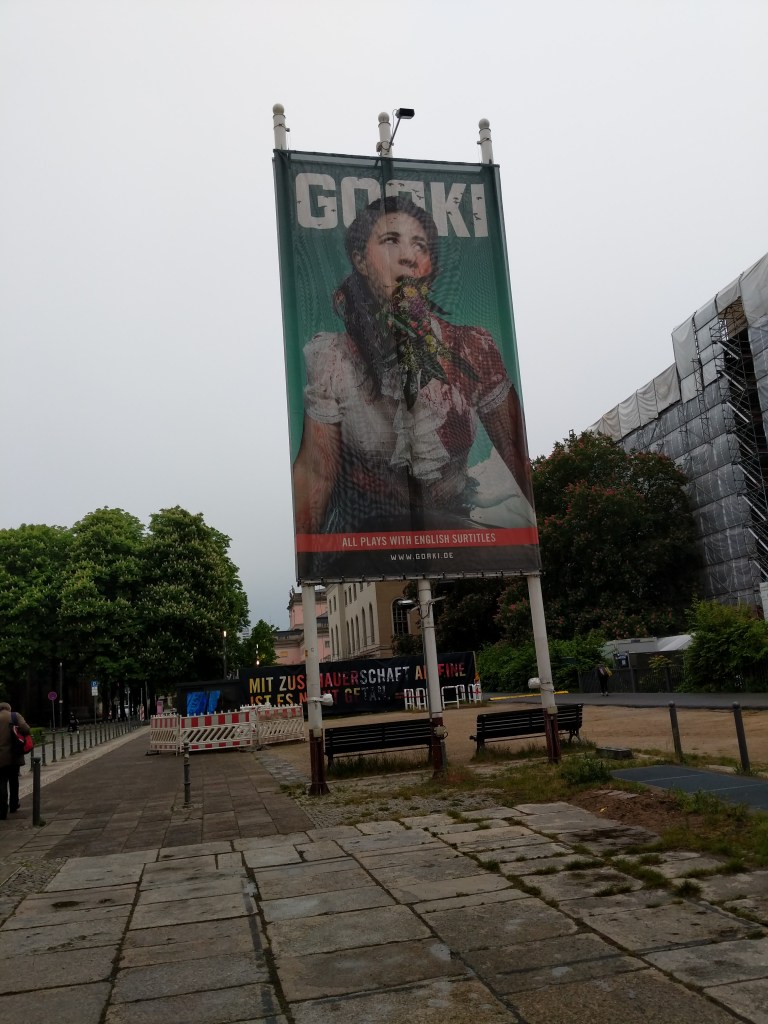
Every city must have one, a theatre and preferably one that’s as avant-garde. I have a feeling that cities like Kolkata would have one just like the Gorki Theatre in Berlin.
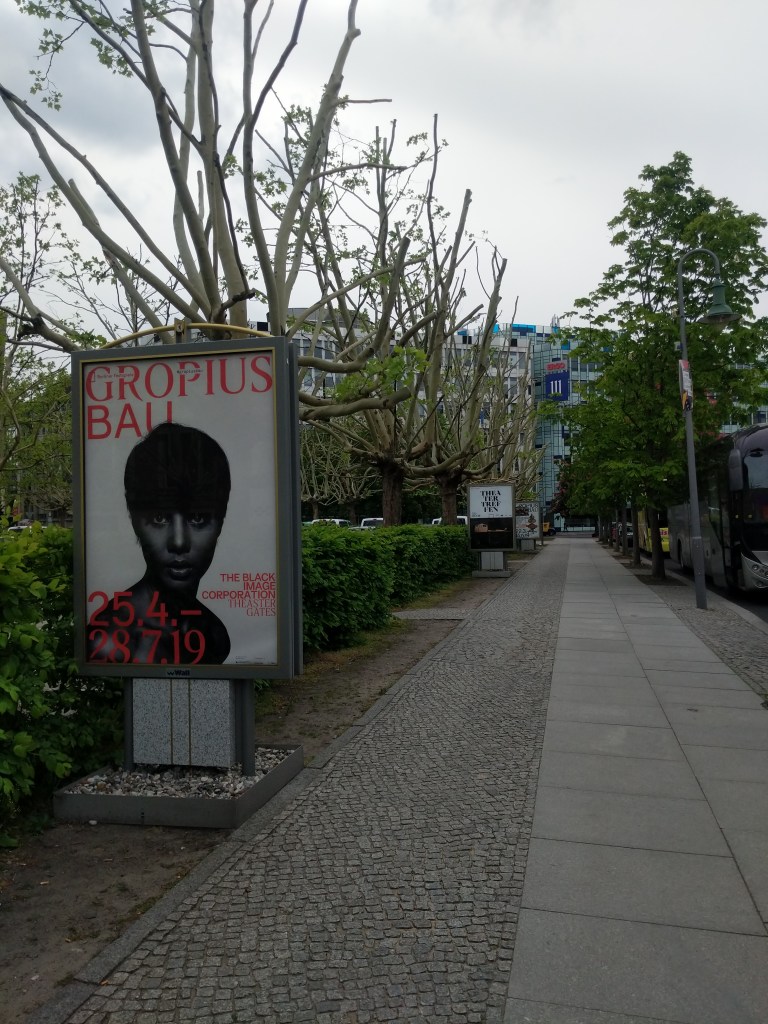
This theatre is in a block opposite the Museumplein. I just happened to see it because I was walking from one of the metro stations towards the museum, when I saw this outdoor hoarding. There was a play announced for later in the evening (or was it the next evening. I’ve already forgotten). Already 2019 seems so long ago. In May it will be two years since my entire Euro-trip.
This poster really caught my eye, a woman with blood smeared all over her as though she had participated in a ritualistic blood-fest. The play that was scheduled was ‘skelett eines Elefanten in der Wuste“. However, what play was on didn’t make a difference, I was more interested in what Berlin plays were like, and how did they have subtitles in english for a play?
So later in the evening of the same day, or the next, I trekked back to the theatre. The entrance was unassuming, as most entrances in Europe seemed to be. Just a small door in an alley. Very very matter of fact. This was also just after the general elections in India, so really I was in the mood for a much less dramatic existence than the Indian experience can be.
Inside, the lobby, was full of young Germans who looked like students and activists. Aren’t they lucky to be able to express themselves, unlike our stifled youth? There was beer instead of Coca-Cola, cigarette smoke and German words and German laughter in the air. When you are a foreigner, and a small brown-yellow one at that, and alone, it can be a bit intimidating. So I wandered and made my way into my favourite space in any new setting…la loo.
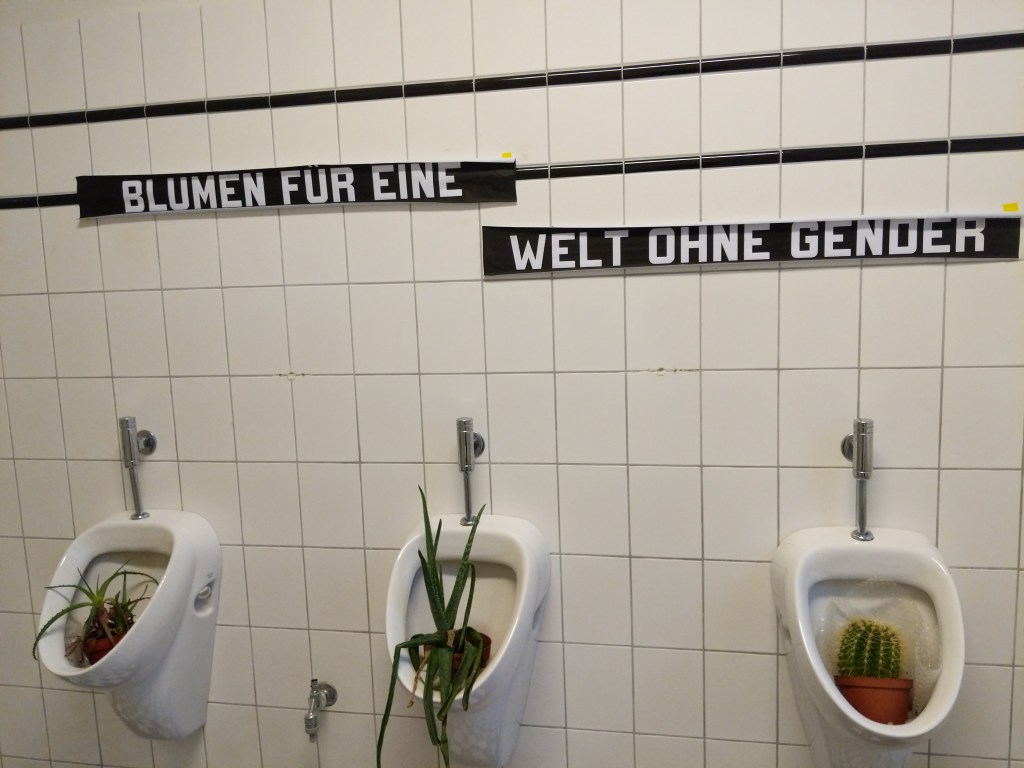
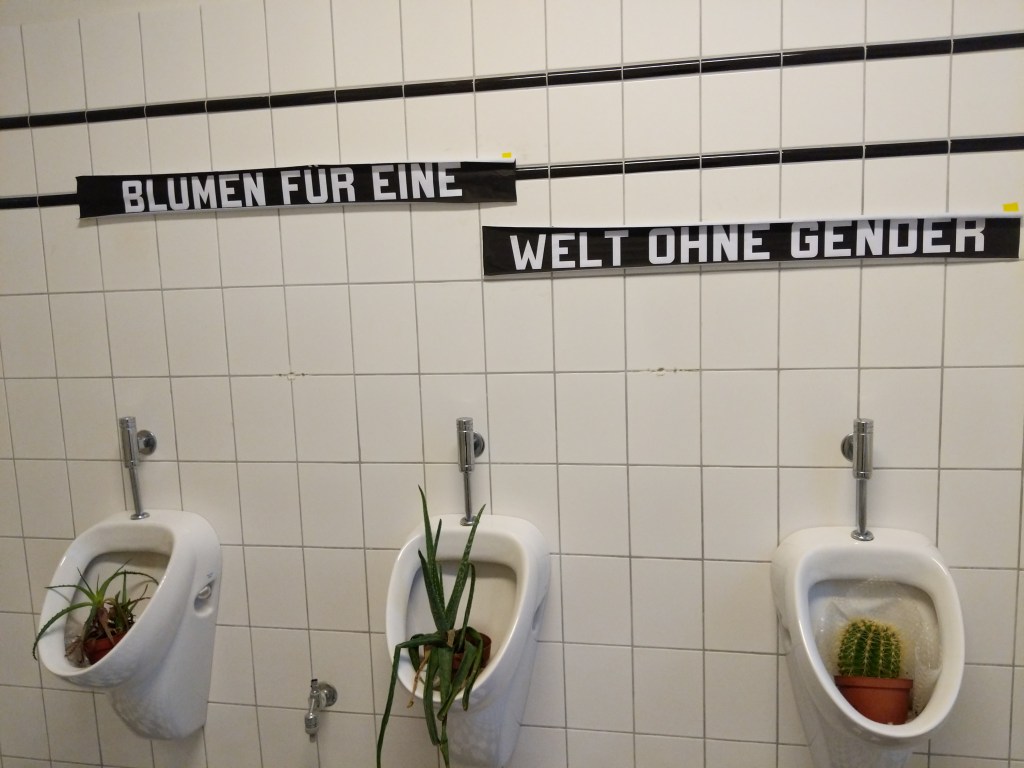
>> translation from Google translate: blooming for a world without gender. Bit idealistic I’d say, but anything must be possible in countries like Germany. <<
By the time I came back out we were ushered into a darkened theatre space, a narrow performance space with the audience seated in three layers all around. The mystery of the subtitle was solved, they had discreet monitors overhead. I can’t say I understood much of what was going on, between trying to read the subs and catching the performance in the dark. All I remember are dark colours, flashes of white theatre light, unexpected and off-stage entrances (!) and yes, that tantric/oriental/arabesque dance which always gets to me in a primordial way [see trailer below]. I still remember a bar-dancer in Bangkok who danced to electronic music with traditional moves. Something about dance and music transports me from every grey european city into the jungles of our mind.
Afterwards, I carried the flyer and the ticket and saved them. Because these are all reminders of a youth I could have had if I had been braver perhaps?
“Really cozy and strangely horrific pub, a rough spot tucked into some of the finer quarters of the city center. Much appreciated!”
says a review of Eschschloraque Rümschrümp on Foursquare.
I did not even know I was near this pub somewhere in Mitte, the night I went out with a fellow desi I met at the Circus hostel. [Sadly I have forgotten his name so I’ll just call him X].
We strolled down from the wonderful Circus Hostel, and we kept walking, looking for things to do in the middle of the night in a city we were not familiar with.
The thing is, if I hadn’t met him, I would never have seen much of the night life in Berlin. I travel alone, and with the typical guarded sense of a South Asian (scratch that…Indian) woman, with my own set of paranoia. I would never DREAM of walking down empty streets in the dark.
Which is what most of the European countries turned out to be. Really empty, absolutely empty. Not even dogs roam the streets of the western world. Maybe they are used to it. But to me, growing up in India’s perennially crowded streets, this is like walking at a really late hour and feeling very alone and unsafe.
So, thankfully I met friend X. While I was a day-bird who spent all my days at the museums, he was basically the opposite. Slept until quite late in the day and then was out, with a small bottle of JaegerMeister tucked in his front pocket “cheapest way for us desis to get drunk in Europe, is to buy this baby from a convenience store“. And because I thankfully spoke to him at the hostel, we made a plan to go out and check out the night scene in Berlin.
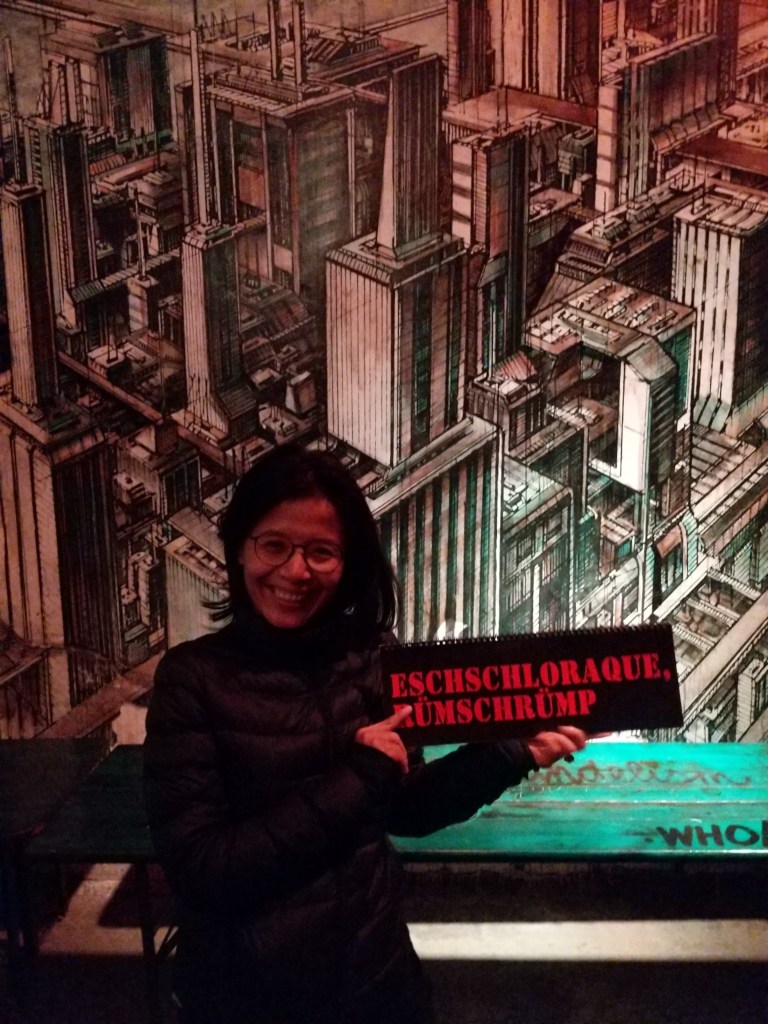
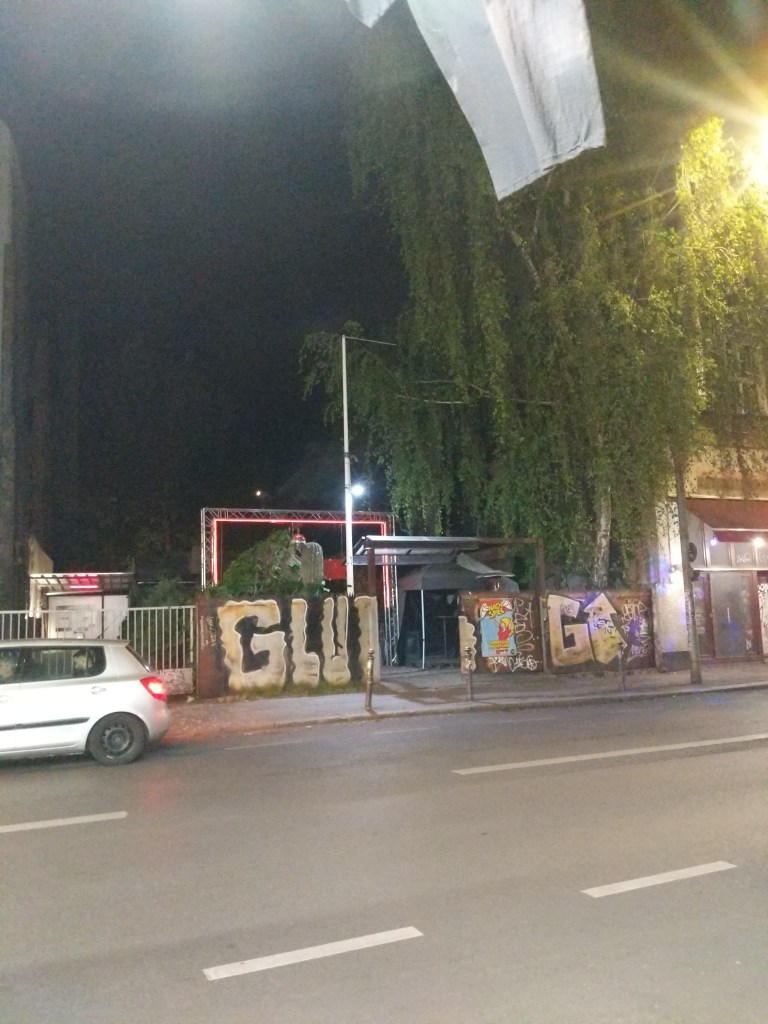
We were walking down a street after some burgers on Alexanderplatz, when crossed a little corner teeming with graffiti. Perhaps it was still early in the evening, because there was, again, no one around. That’s when I took this photograph.
>> i was laughing at our attempts to pronounce this <<
It was only today, when I was going through my photos that I realised I was holding up a placard that said “Eschschloraque Rümschrümp”, and only when I tried to find out what that meant that I realised it was yet an underground bar in Berlin.
That’s the thing about Berlin, you never know that you are outside a pub, or anything outside of the stoic walls bathed with posters and graffiti; which is so cool because that year I was beginning to be surfeit with India’s over-exhibitionism.
When all that you are, is on display, it begins to subtly affect what you choose to show, and why you do what you do. All the drama of our news channels, our “patriotism” worn on fragile sleeves, our moral values infringing on everyone else’s; Berlin was a sharp contrast to all of that. Ironic in a way…considering its history. But perhaps that is also what is so hopeful…that one day, even we, who currently aspire to be little fuhrers, will one day break free, from the shackles of group-think.
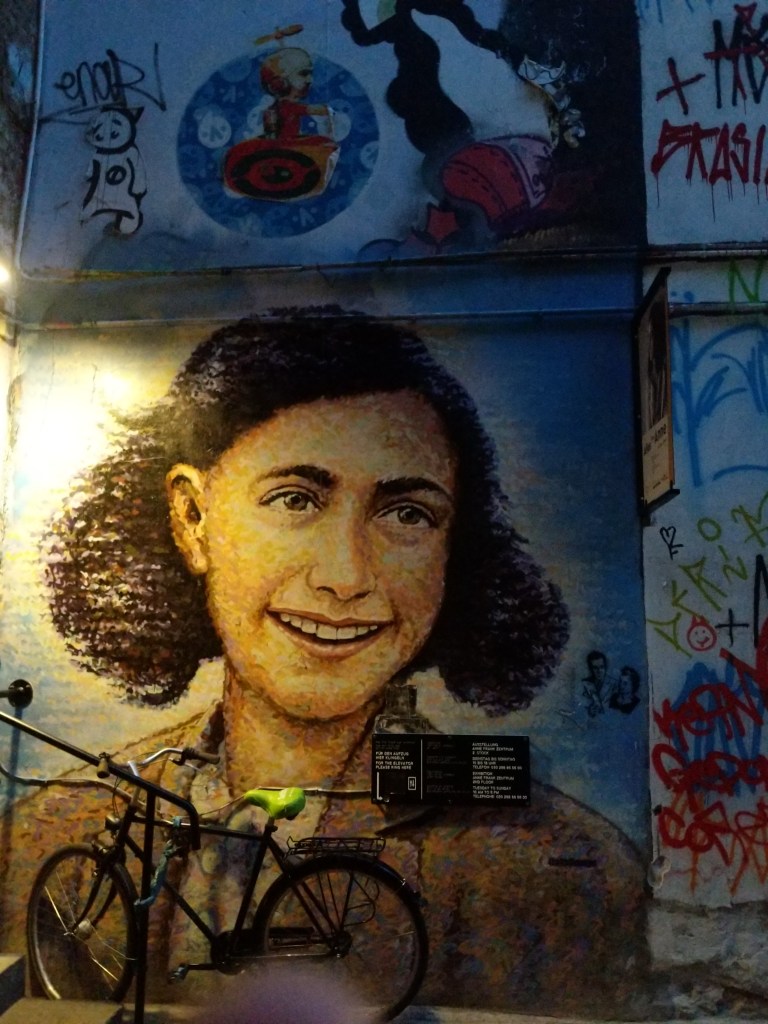
>> Anne Frank will live on <<
Meantime, onward ho! At some point we started looking for a disc (ancient word, I can’t remember the more trendy word– ah club), that X had heard about from a friend. We finally found it, on a quiet empty street. Unlike India (or shall I say, Delhi? :D), the street outside was quiet and not lined with parked cars. No hawkers, no random women falling over, no men hanging around. People slip in and slip out, and one would never know.
Unless we were too early, this is exactly how empty and quiet it was. So we went up to the door, and basically got a good hard germanic stare (droll). We were asked if we were wearing anything underneath our decidedly boring jackets. X zipped down his jacket, good old sweater beneath. “And below that?” she asked. He was like “Umm, my tee shirt”.
“and below that?”. OKayyy, time for us to leave now 🙂
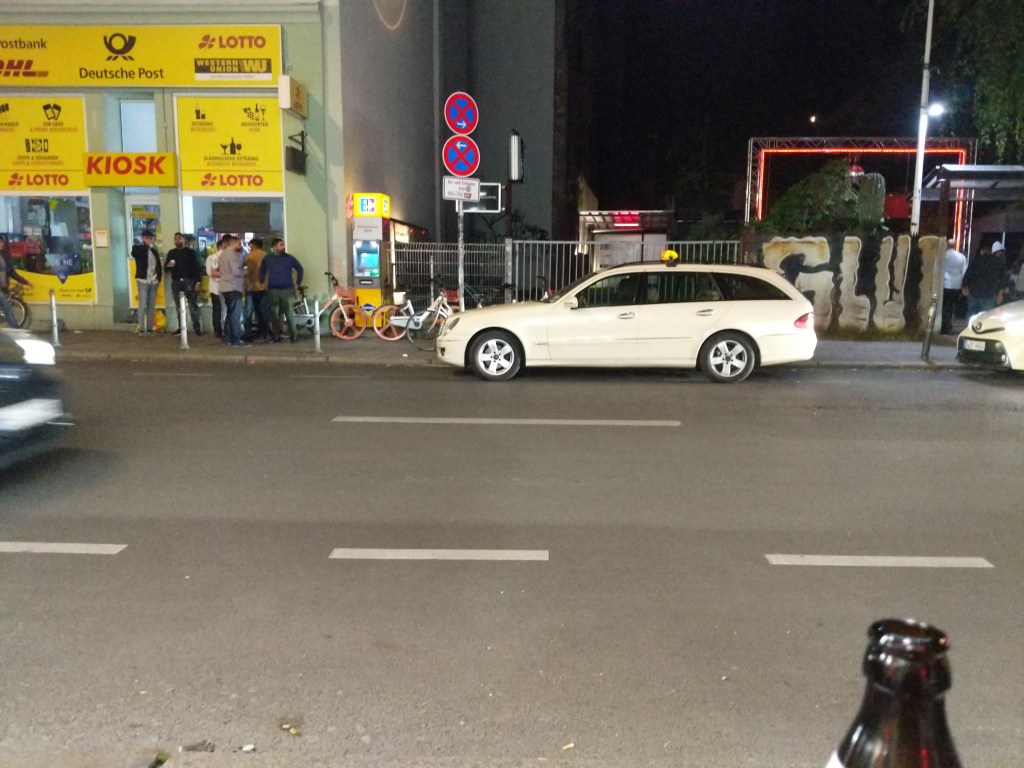
So we did a small hop skip jump over to the other side of the street where X decided to top up on another Jaeger and get a couple of beers. We sat outside the store laughing about the whole thing, when suddenly…the street erupted. A taxi dislodged, quite literally, a dozen young men. They all go out laughing, drinking, hooting, very excited about the same club we’d just tried to get into.
They looked middle-eastern, they talked with an almost Cockney accent, and guess what…they were of Punjabi origin! Soon, X (also Punjabi it seems), was out there hugging-shugging, and even me, trying out the little stereotypical Punjabi phrases, only to realise that the Punjabi they spoke was even more “theth” and unintelligible to the average non-Punjabi 🙂
After offering us their drinks (I love how our Asian genes are still so strong no matter where the descendants ends up), they crossed the street to try their luck. X and I grinned at each other as the bunch of good old hearty boys went up, and in five minutes were calling cabs, waving goodbye to us as they rushed to a less esoteric pub-shub.
We finally ended up at a club too, a regular one. The kind where you dance the night away and not find cabs on the way back. Quite fun.
It’s a very cold day today, so I am going to skip the chronological order of my travels and jump to warmer climes!
Around mid-May I was done with northern Europe (the little I saw). Yes lovely it was, but also cold, and rainy. Just like my hometown. And I was starving for the sun, like the strange creature of summer that I am. Even in India, my favourite weather will always be the warm, soft and heavy air of the western coastline of India.
So anyway, there I was in Germany, loving Berlin, but also dying to get to Greece. Europe deserves atleast a month, and Greece? well frankly I hope I can do Greece again in my uncertain life. Maybe I could just die in Greece? Such a beautiful, ancient country.
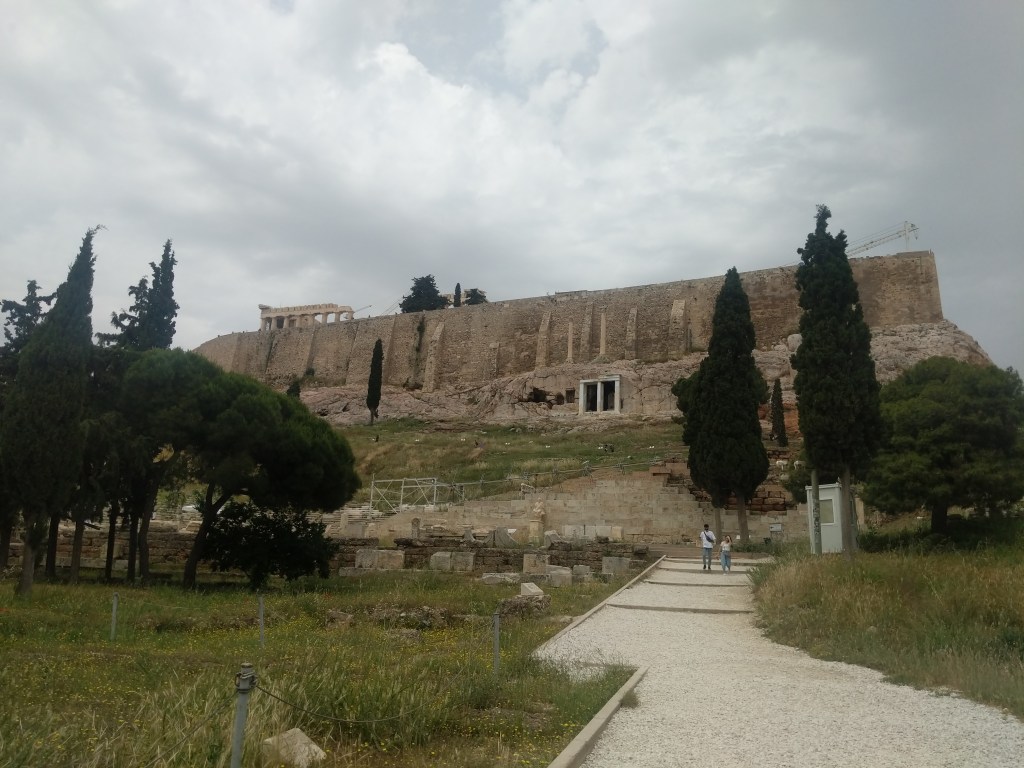
My first evening was mostly me walking around Athens looking for my friend’s apartment. The next day, the lovely Acropolis…which was happily for me, quite close to her place.
W\hat can I say about the city on the hill that others have not said better? Well for one, I wish I had finished reading the book that I am reading currently “The Marriage of Cadmus & Harmony“, because that would have made me look at everything with an even livelier curiosity. Not to say that I haven’t always been fascinated by the ancient Greeks. Call it the vestiges of a euro-centred English education that I was exposed to when growing up, or the cultural hegemony of the west (!), but I found Greece fascinating.
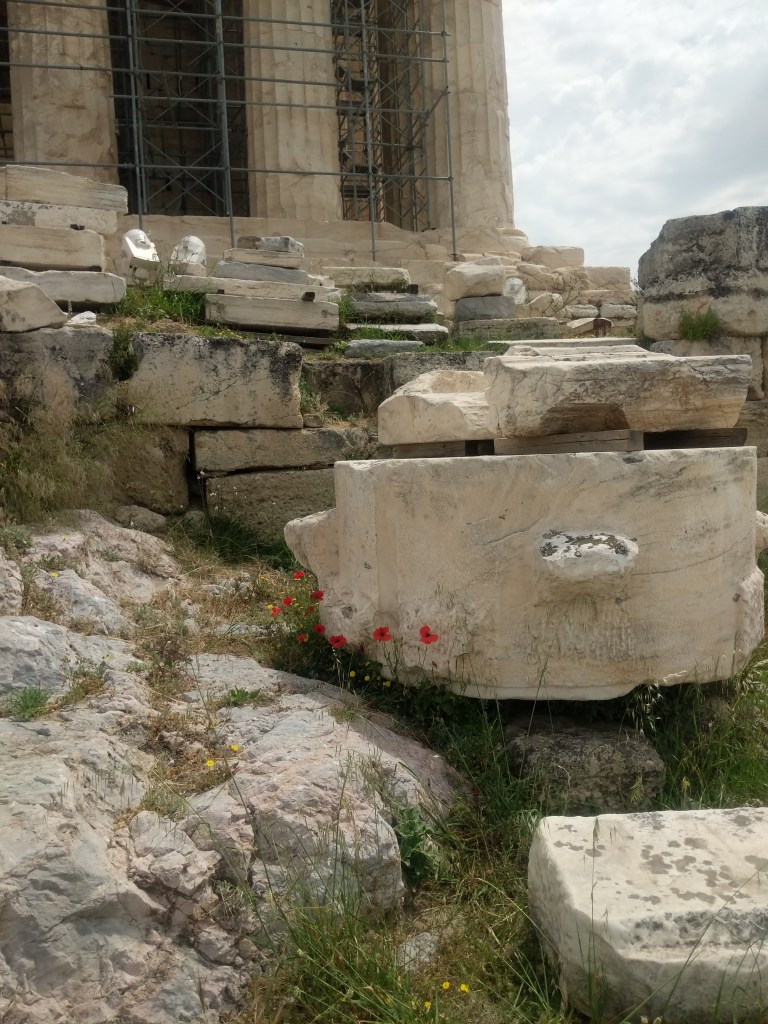
Or maybe it’s the fascination that I have always had with the dead and decayed, the remnants of human civilisations and the incongruous outcroppings of the past in the middle of our lives. Athens is like Delhi in that sense, the past lives next door to the present. The Greeks are not as fastiduous and perfectionist about the past (yes, like us), and so there is a past all around the present, crumbling but still gloriously and incomparably beautiful.
>> the past, the present and the fleeting lives of little flowers in the Grecian sun <<
As I was walking up the gentle slope I was happy, happy with the sun shining and the brightness of the day. Happy that the crowds were still lighter than I expected, and keen to explore the quaint streets below the Acropolis. The city sprawls all around the ancient hill (or is it a mesa?) and I was wondering…did the ancient Athenians live only around the hill? Or were they also sprawled across these lands which would have been more verdant then?
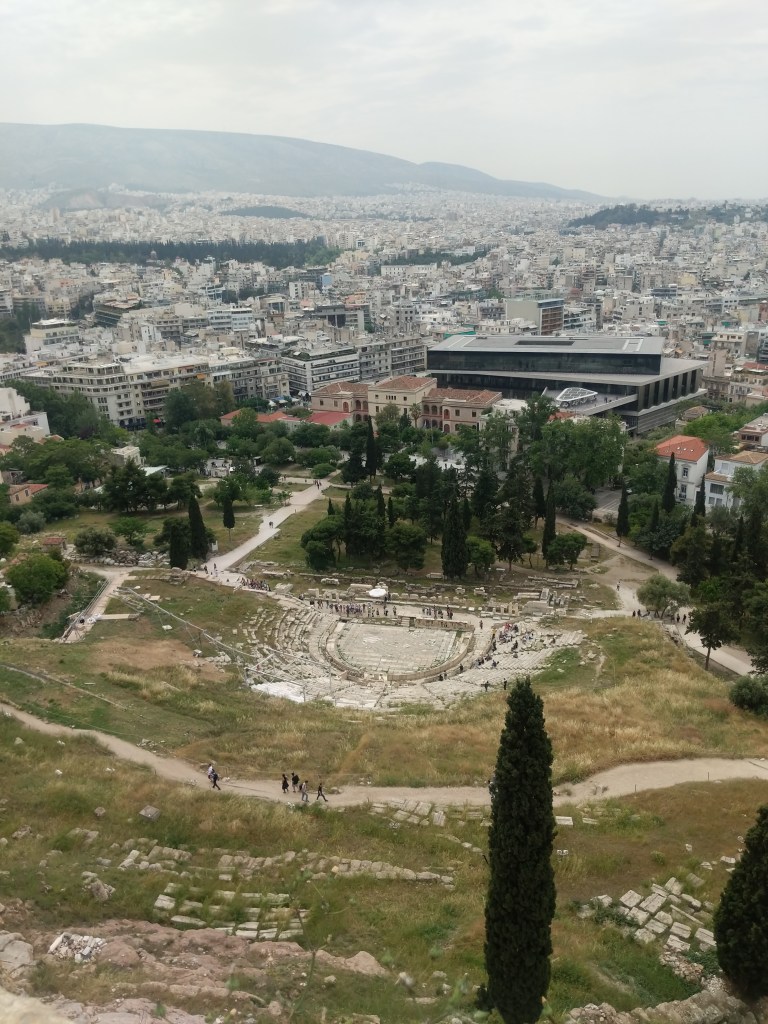
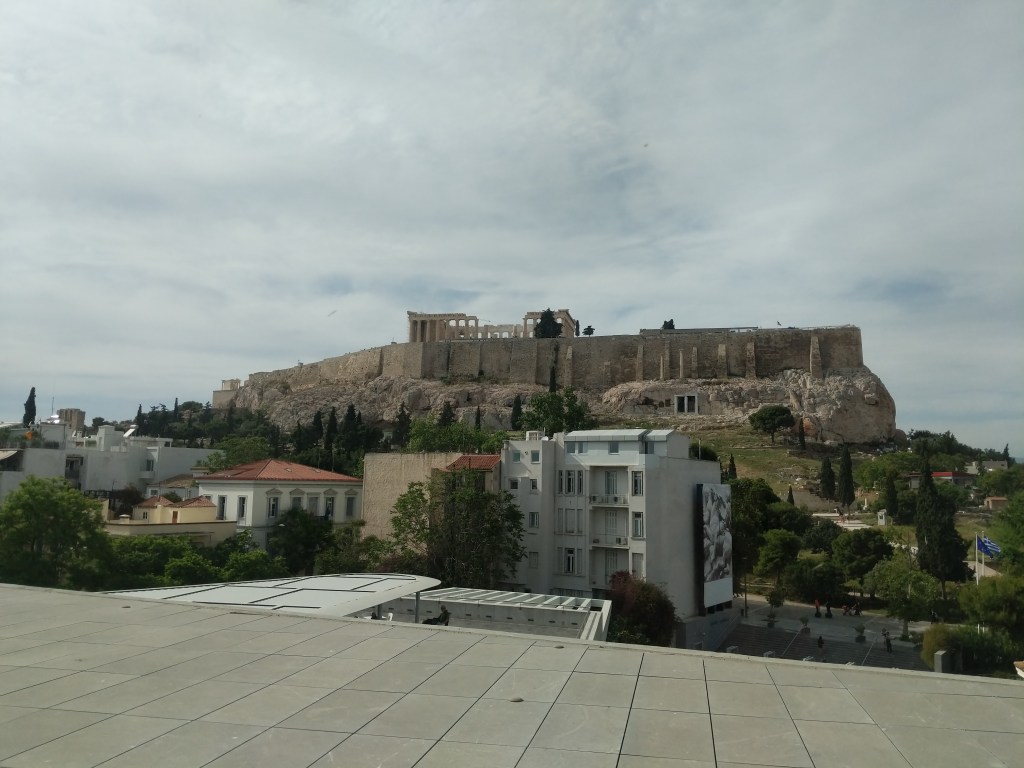
>> a view of the new city, from the old. At the bottom of the hill, that modern building is the museum. And I just noticed the museum cafe on the triangular terrace as well . The ampitheatre is the ‘Theatre of Dionysus” <<>> and a view back at the Acropolis from the cafe at the museum <<
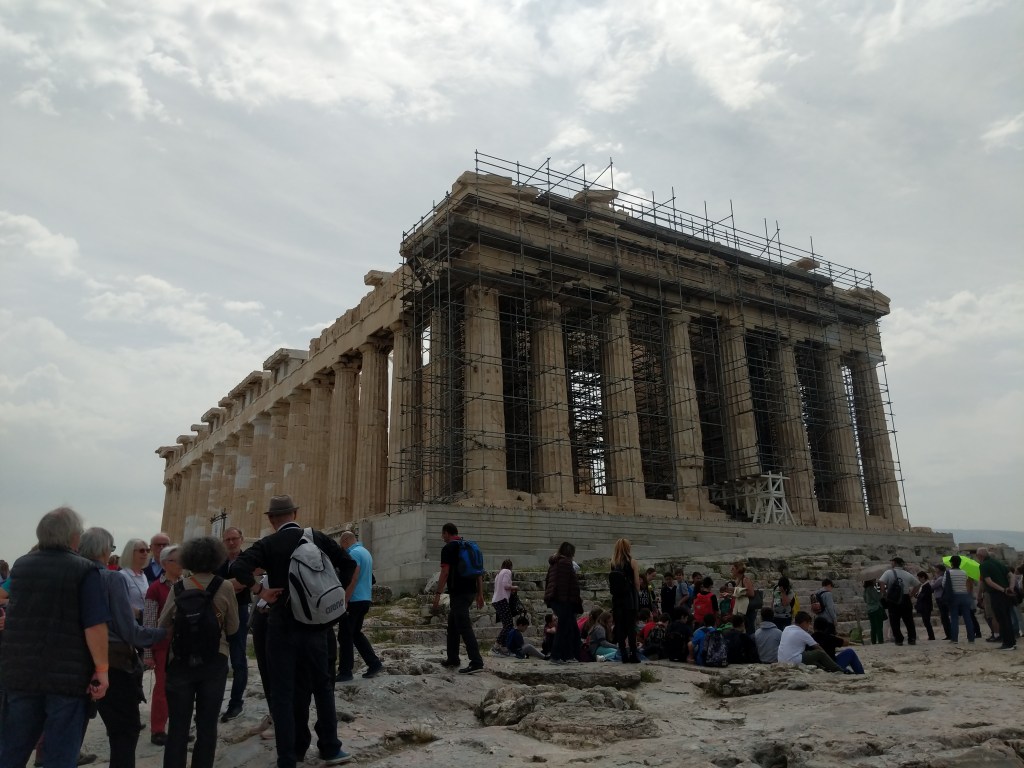
I stopped all along the way, listening to a very handy guide from Rick Steves, the audio guide that is heaven-sent for travellers like me. It was getting warm up there on the hill, the groups of senior citizen tourists were getting visibly tired, but I walked all around the Parthenon, with Rick cheerily chirping into my ears.
>>The Parthenon- solidly beautiful, even when surrounded by tourists and back in 2019, getting some structural repairs <<
[An aside: I think it was after the Greek tour that I also started noticing how heavily influenced by these ancient columns the American Capitol Hill is. But then it’s always interesting to see how influential the Greek civilisation and architecture has been]
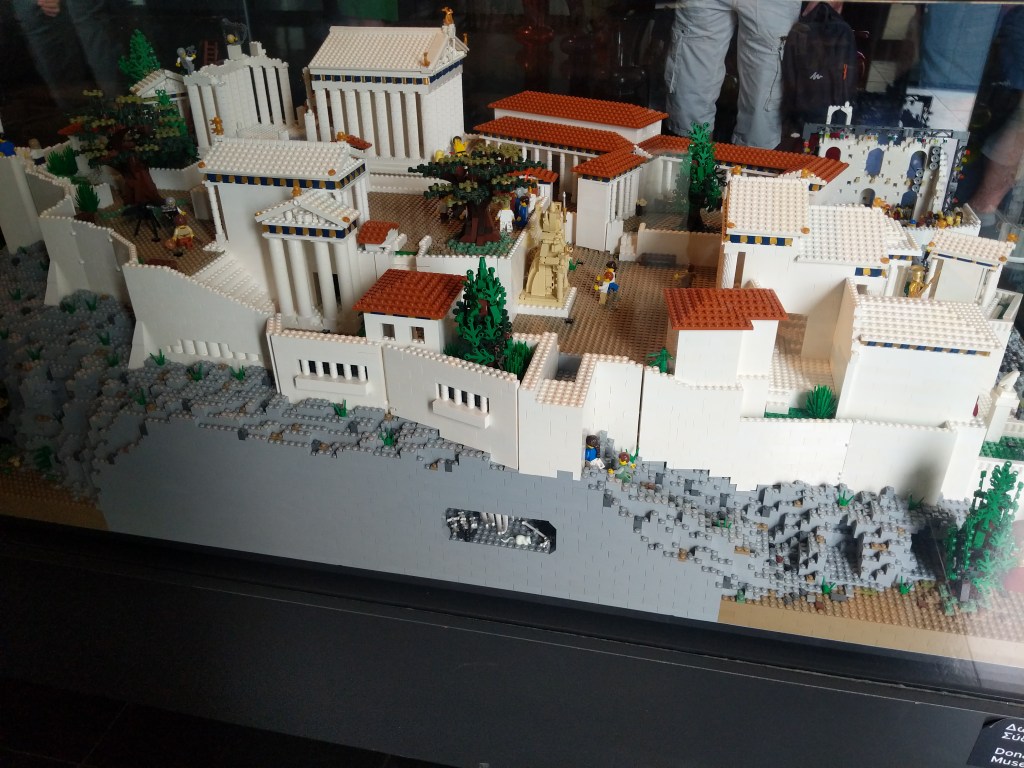
>> I also managed to see a Lego version of the Parthenon at the museum, quite cute I think <<
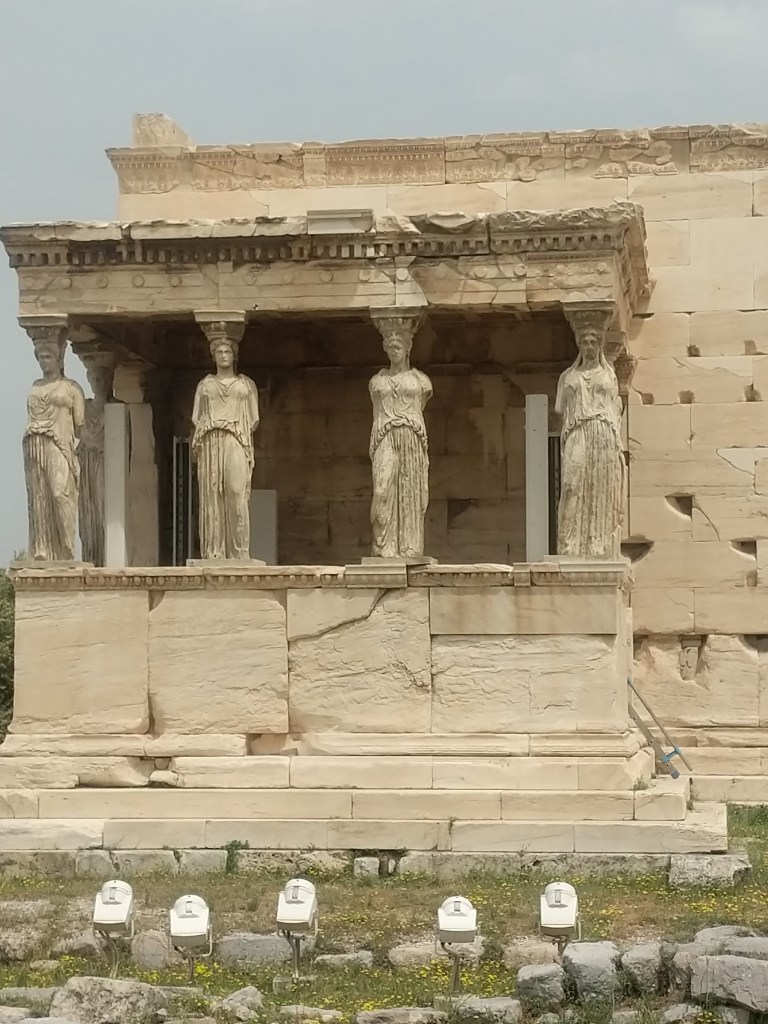
>> The silent women looking down at the world for centuries. The original caryatids are in the museum, liquid and wavy like their thick plaits of hair. As Roberto Calasso is fond of pointing out in his book “Once you have a double on the scene, it’s like entering a hall of mirrors; everything is elusive, stretching away into a perspective where nothing is ever final.” <<
Athens of course was named after/by the goddess Athena, and the founding stories are incredibly interesting. Again Calasso (should have read the book before Greece!) in his book has an entire chapter to this, including the myth of the serpent guardian etc, but I will leave that for you to explore.
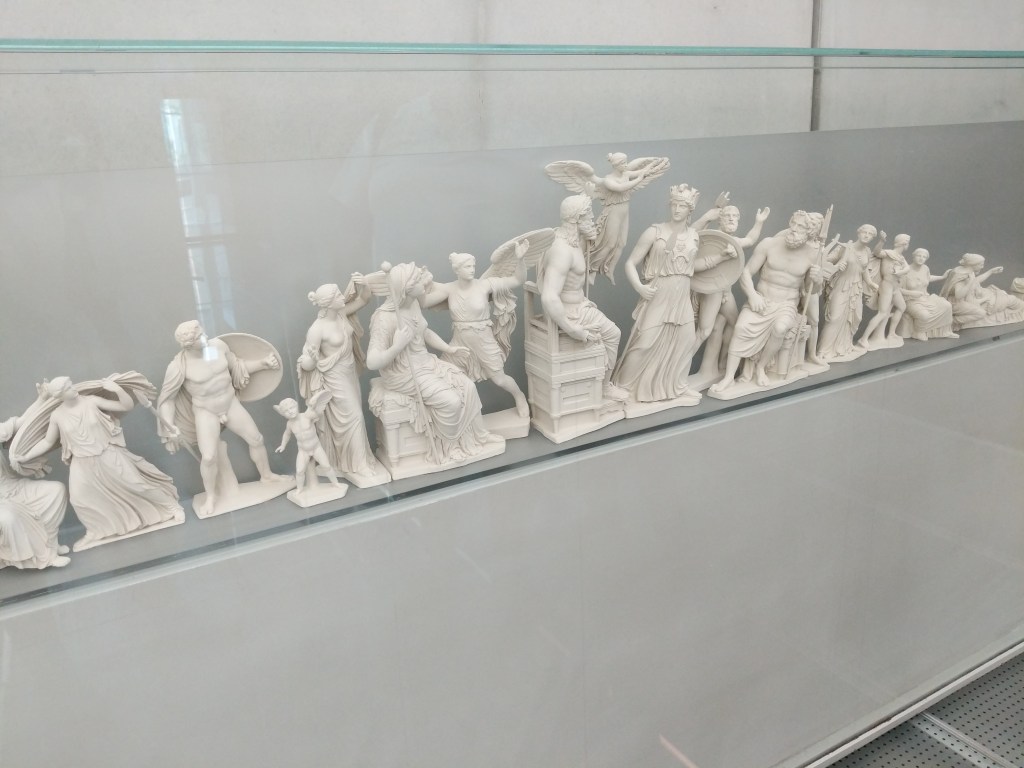
>> a copy of the Elgin marbles which are currently at the British Museum, depicting the birth of Athena (seen here with shield in hand facing her father, Zeus, from whose head the goddess erupted) while “Nike fluttered around her with a crown in her hand” Beautiful work, especially when you realise these were made in 400-500 BCE <<
What has always fascinated more, is how a story becomes a ritual after many years and centuries without anyone remembering why they do the things they do.
In this context, Calasso talks about the ritual of young Athenian girls who had to carry a box of unknown things down the hill, leave the bundle at the bottom, pick up another and come back up. Both times in the dark, and both times without stopping to see what they were carrying.
In effect they were replaying the story of the time when some young girls opened a bundle that Athena had charged them never to open. In the process, they prevented the immortalisation of Athena’s “adopted” son, the half human-half snake Erichthonius. As they say, never open what you should not little one, or face the wrath of the goddess.
>> finally it was time to go back, but I could no resist another view, another backward glance<<
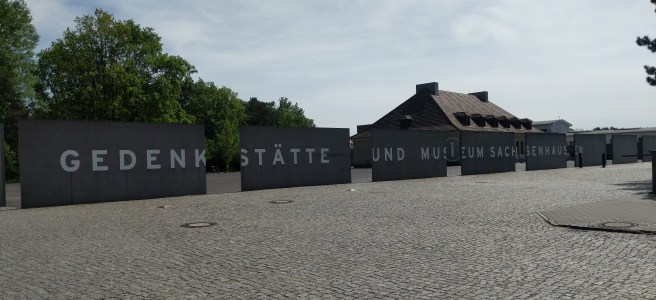
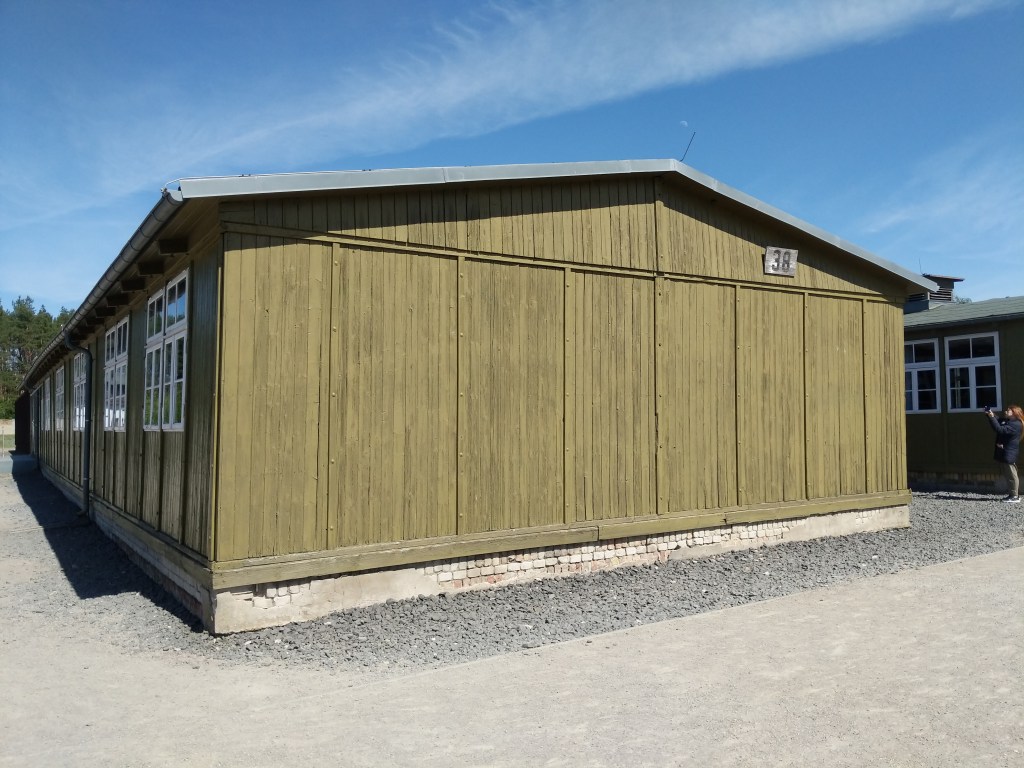
I have been dreading the moment of writing about my visit to Sachsenhausen Concentration Camp. So perhaps I shall do it ploddingly, asking myself questions along the way.
How did I get here? Well initially my intention was to travel across Germany and go to Auschwitz, but with my tendency to micro-plan (on a tight budget), the idea started becoming daunting. I was suddenly also getting cold-feet, the cold and dreary vision I conjured of Krakow and the camps were making me very hesitant.
Auschwitz was out, but I had to visit a concentration camp. In my head, I simply cannot imagine being in a country or continent whose history is defined (for me) by the war, the Holocaust and struggles of human free-will and not visit the places where some very brave and many innocent people perished. Human depravity, I believe, has to be confronted and recognised, and where else would one do that but in Germany, which has stood up so resolutely to confront its past.
Why Sachsenhausen? I almost went to Ravensbruck but I again my budget, the limited time and trying to figure out routes etc. was getting too much for me. So I decided that Sachsenhausen made the most sense. It’s within Berlin city limits (probably it’s outermost tier as it does need a special “C” marked ticket, just like Potsdam), so I could dedicate an entire day to this while staying in Berlin.
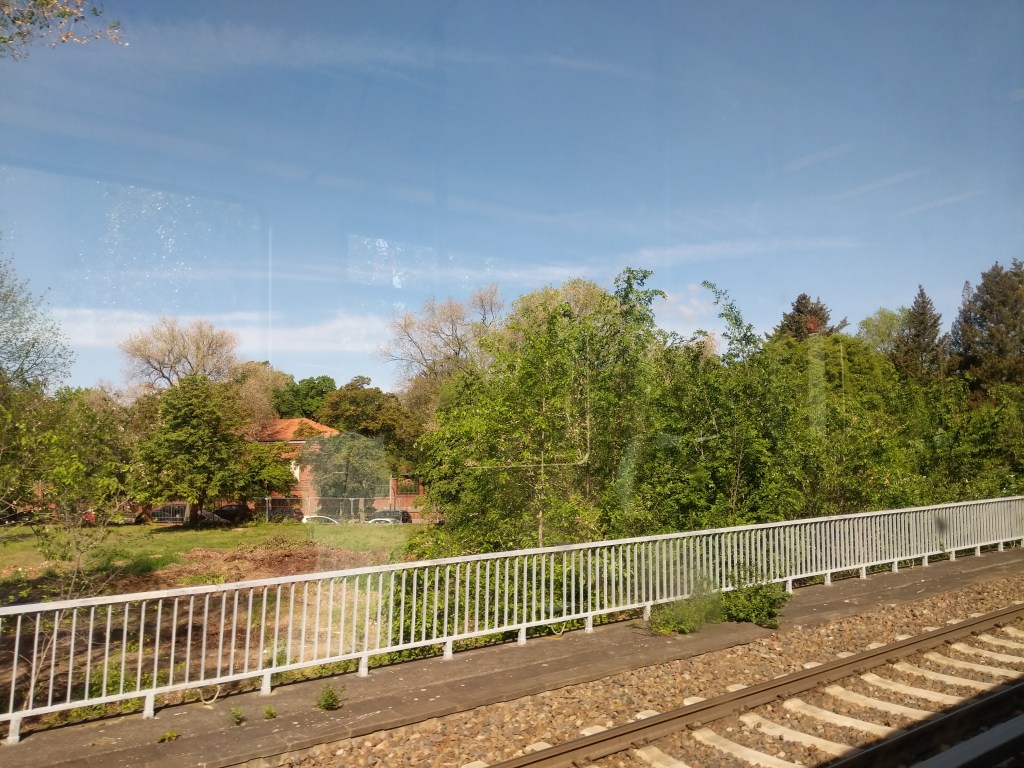
On a brilliant morning in May 2019, I set off on the S-Bahn towards the camp. I can’t remember much of the train ride, except perhaps there was a station called Wannsee, and it reminded me of an English town called Swansea. I was also thinking as I sat in the train, of how pretty the countryside was, and how it must have been for a Berlin Jew to have been on a similar train-ride, perhaps this person looked out (if possible) and saw the same landscape that I was looking at, only with a different outcome to this journey? Were these the same train tracks that led towards the town of Oranienburg?
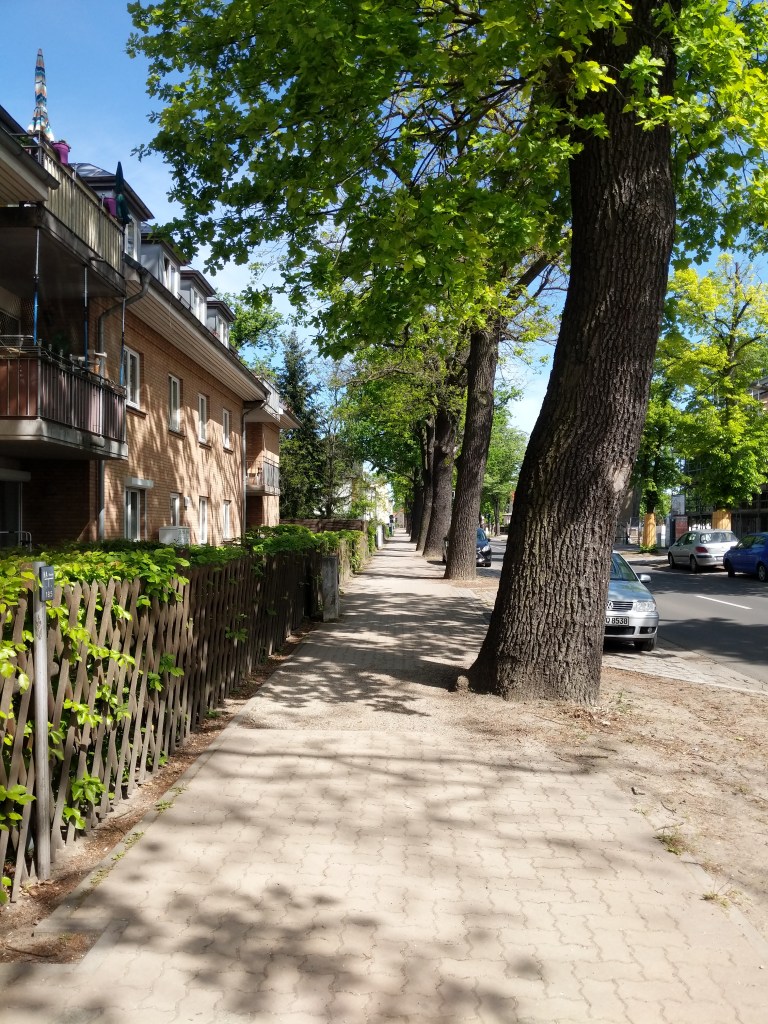
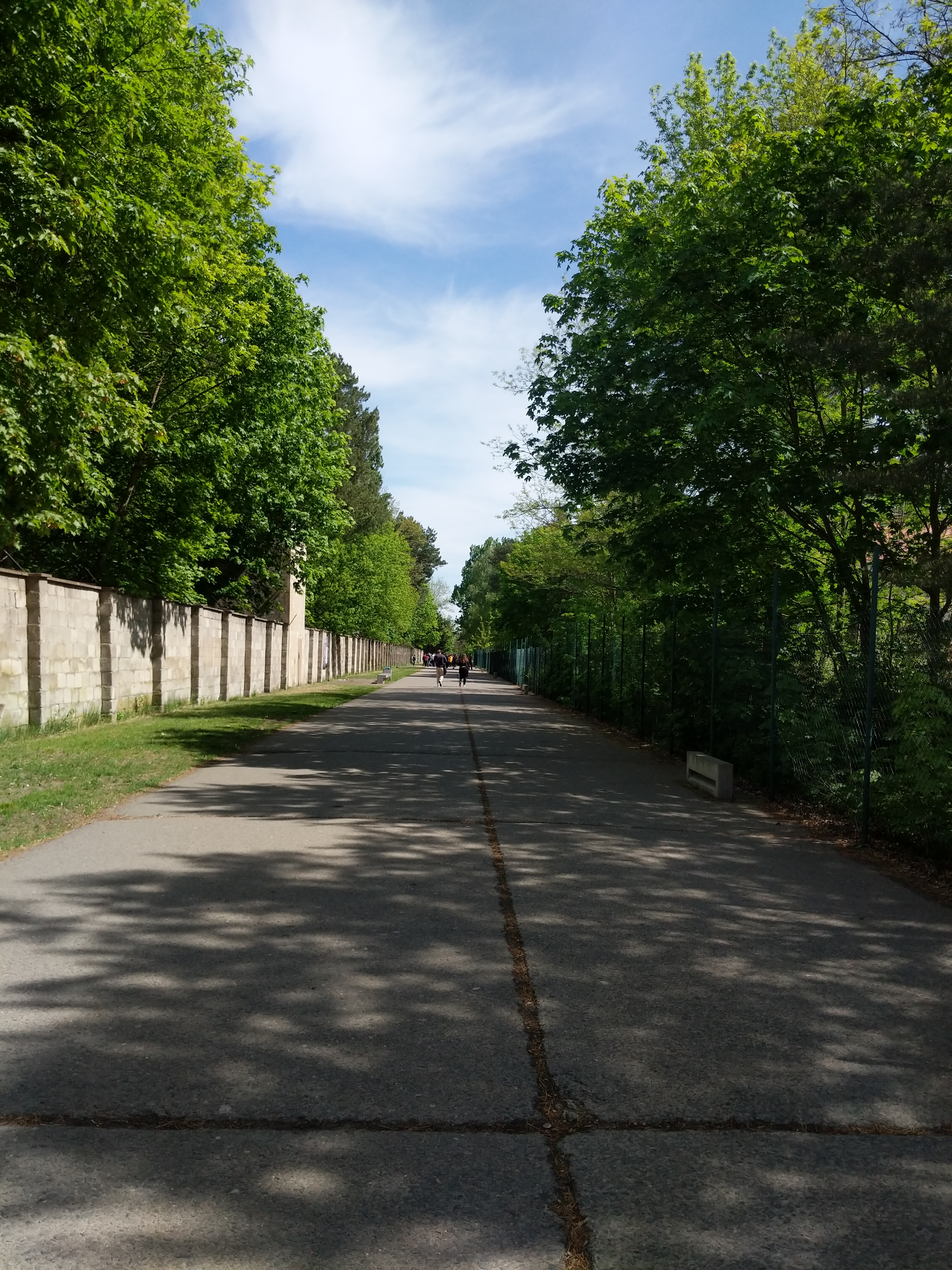
From the station I decided to walk to the camp, along the broad pavements and quiet neighbourhoods (where are all the people in Europe?). Again, I was constantly reminded of the camp prisoners who were also made to walk through the town back in the ’30s, only with a much more hateful crowd jeering at them. Sachsenhausen camp had political prisoners as well as Jews and other people that the Nazis considered “racially or biologically inferior” (ref: camp museum brochure). It also had, as I discovered later, a large number of Russian POWs. Thousands of these prisoners died here. After the war, when the camp became a Soviet prison. The museum brochure that I am referencing mentions 200,000 prisoners in the Nazi period, 60000 in the Soviet era and the death toll is in tens of thousands.
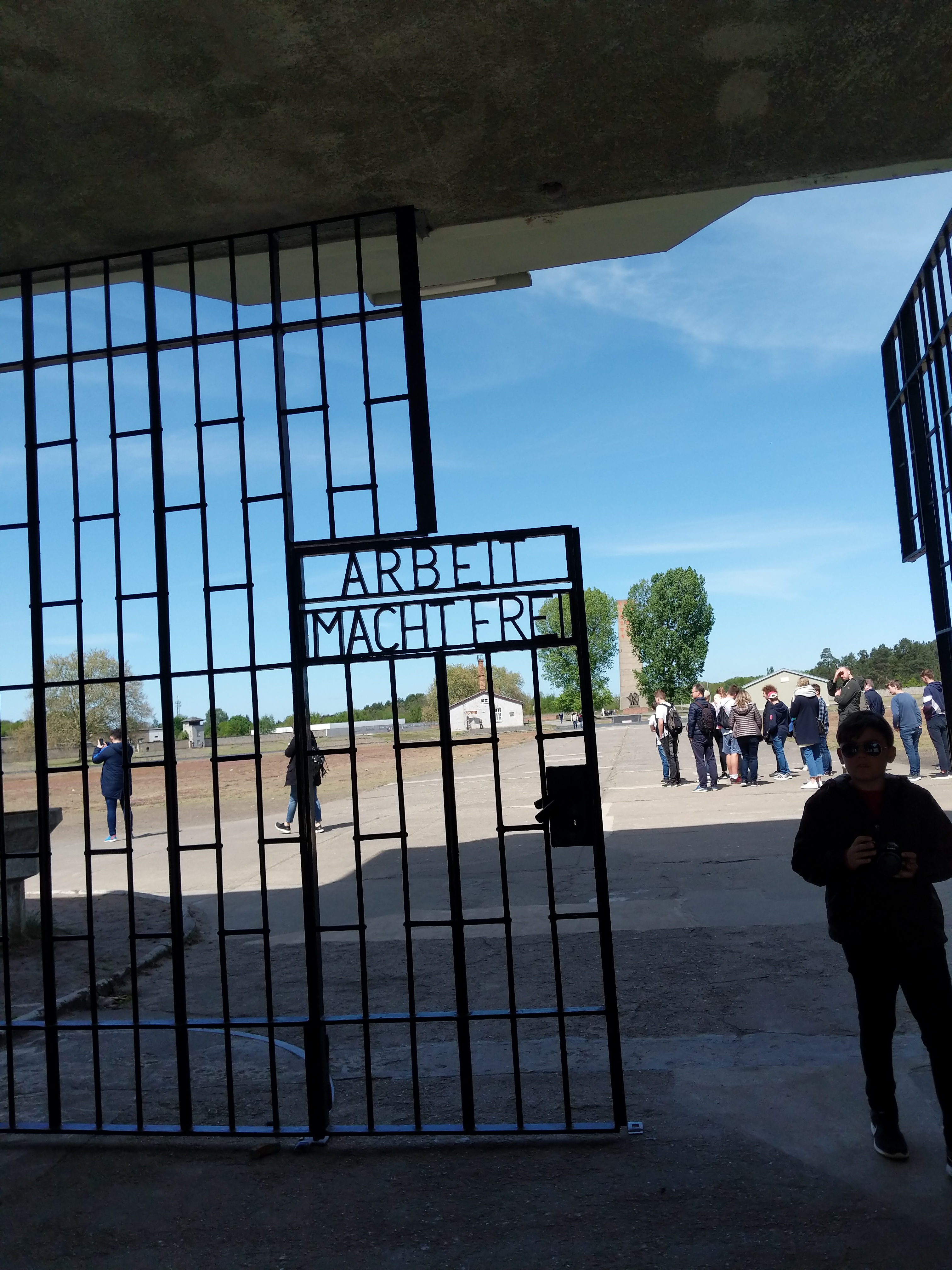
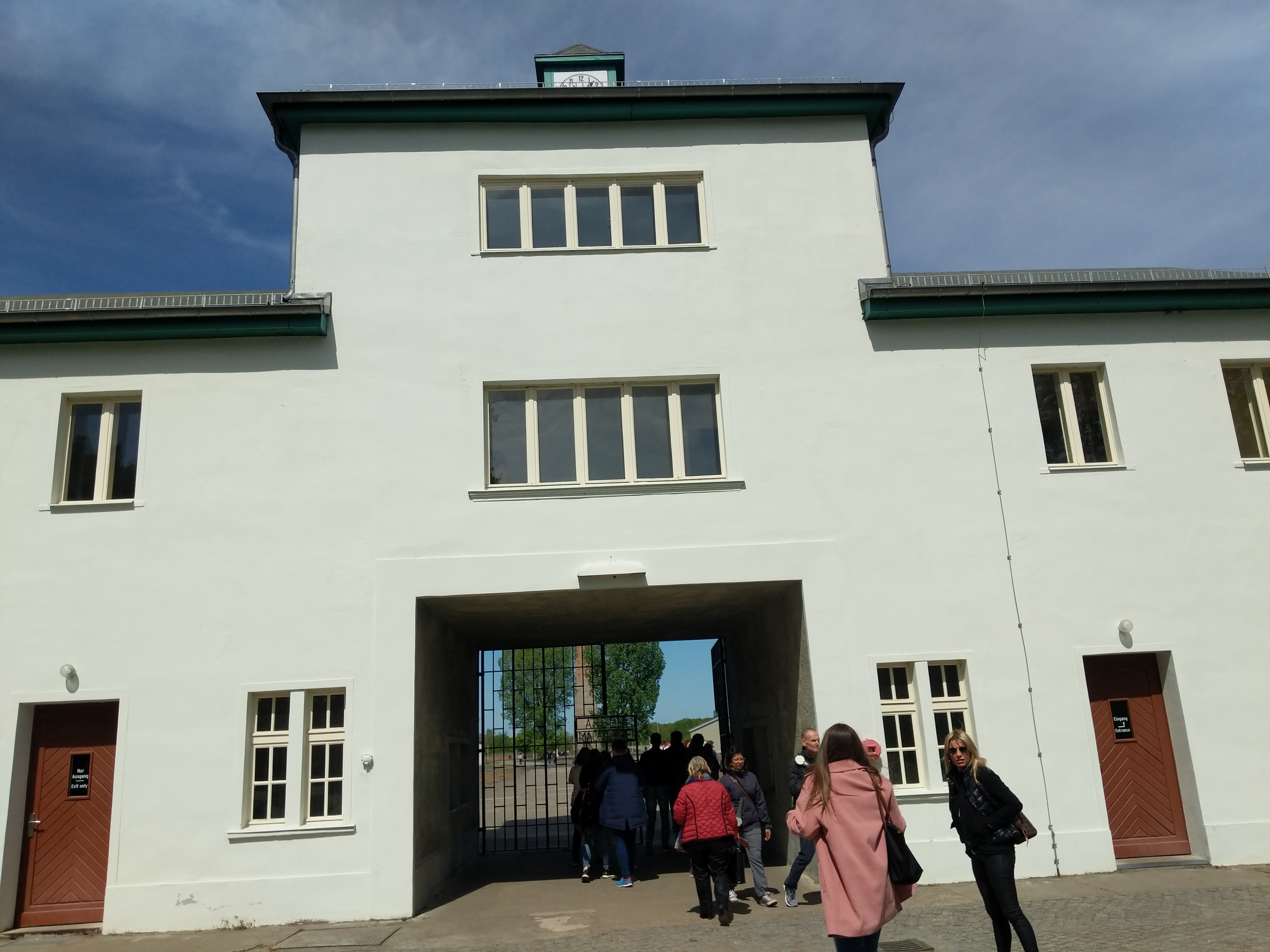
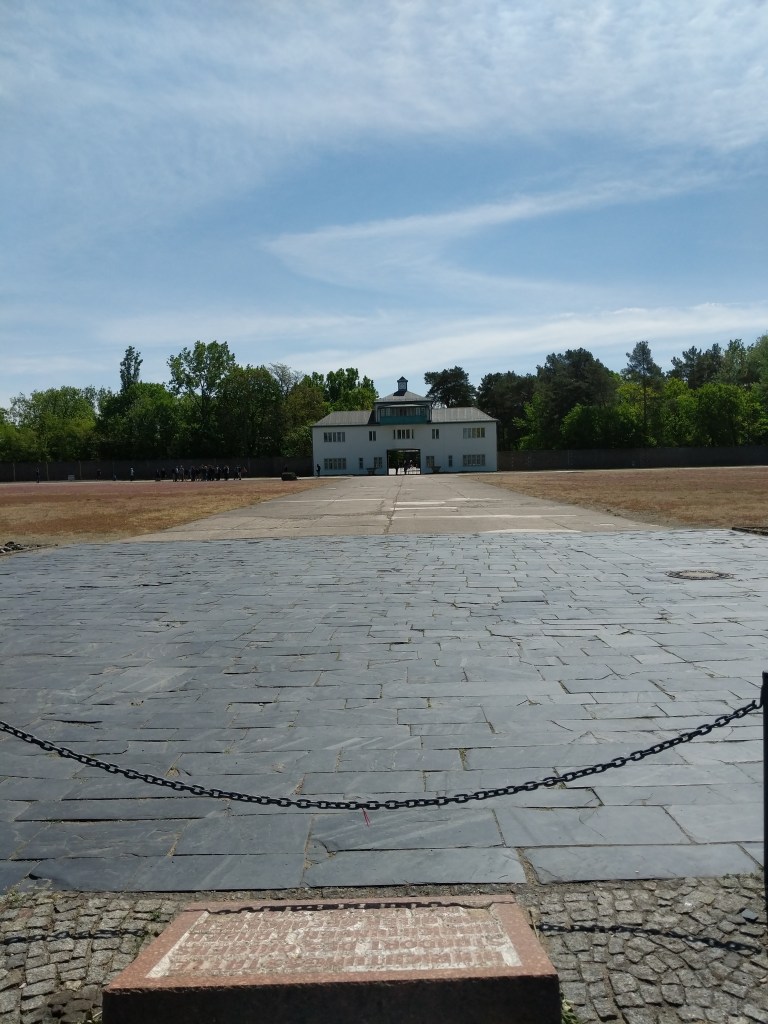
How did we get here? No, I can never quite answer that. Much much better minds have tried and grasped at some or none of the reasons. Even now, when I see these photographs, I am in deep sadness. Always I imagine myself in the shoes of the prisoners, when they first walked through these gates with the horrific words “Arbeit Macht Frei” [‘work sets us free’]. How is it that these geometrically straight paths, the symmetry and deliberate planning hide such a squalid mess of humanity, or did these symbols of order actually delude the Nazis into thinking that they were just managing for efficiency, optimising a service at these camps?
It is to the credit of the various memorial foundations that fund these camps that today we are given access to these historical places, places where people suffered and died. We have been given, almost like a second life, the opportunity to contemplate the ruins and to look at the same view that a prisoner sentenced to death by hanging had. If I were to bring in Tibetan beliefs of past life, I may even be here because I had a connection with the place in a previous birth. [hmmm…past life is not my thing, but it’s a good way to begin to learn empathy].
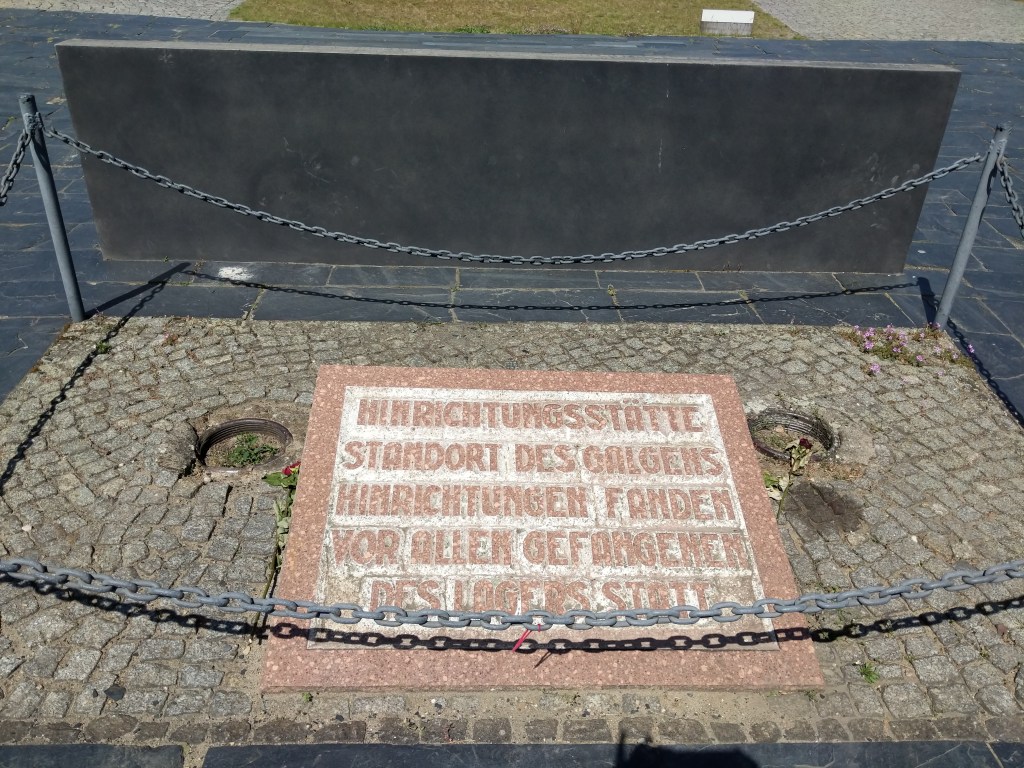
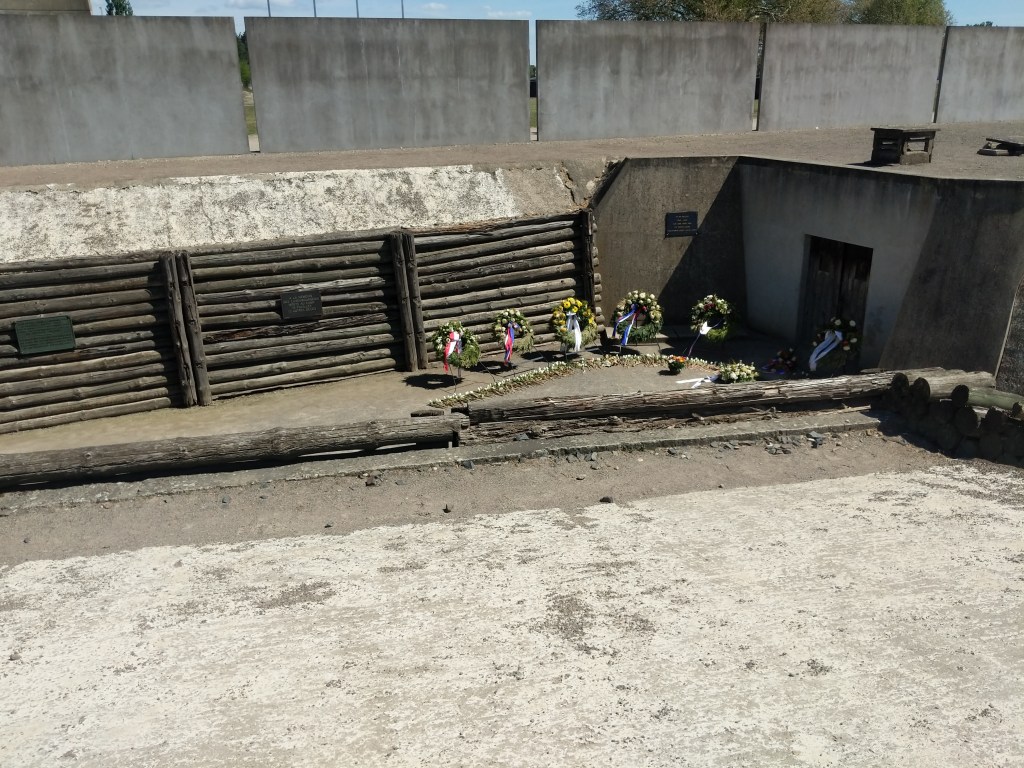
The two holes are where the beams of the gallow stood
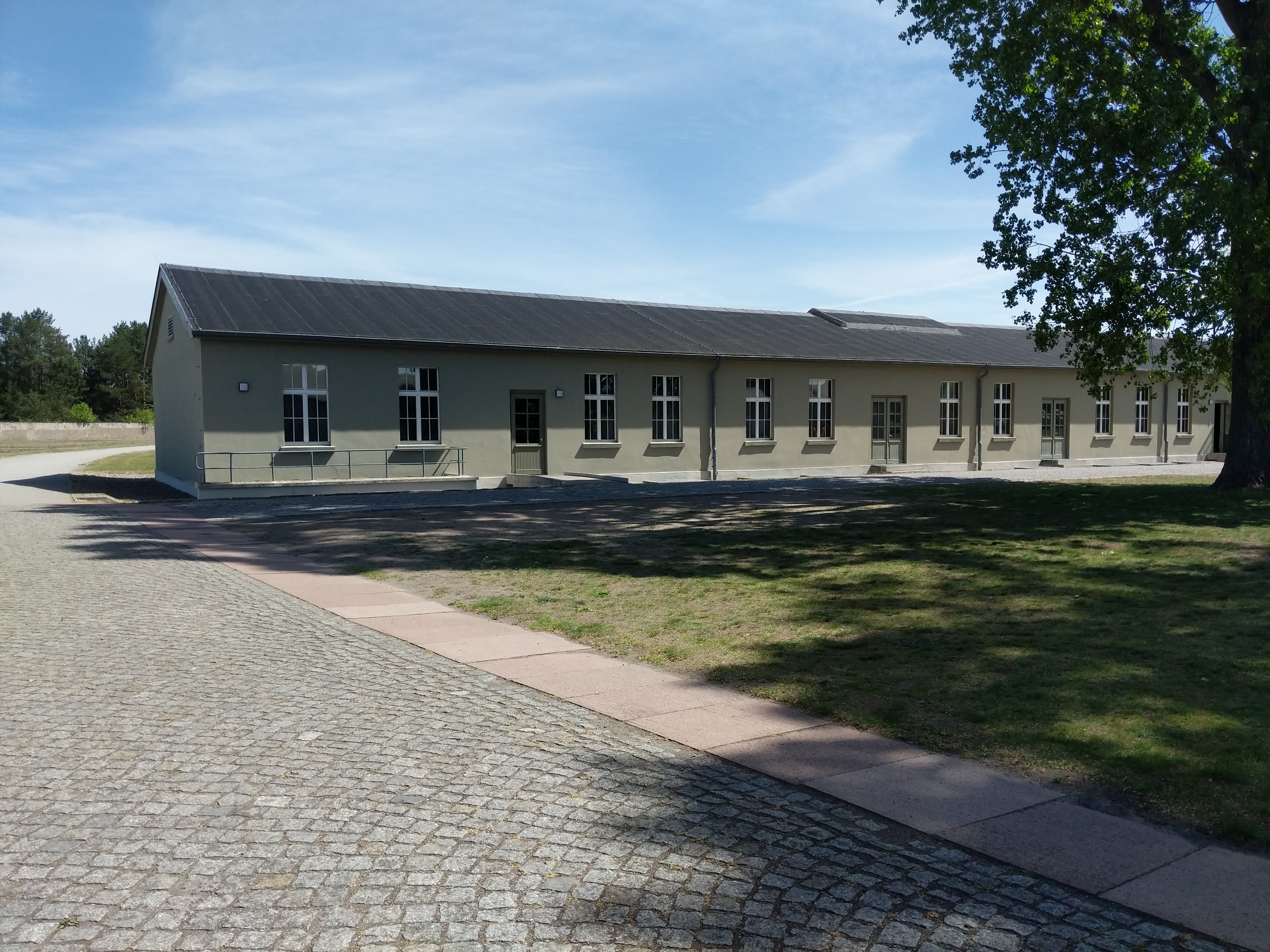
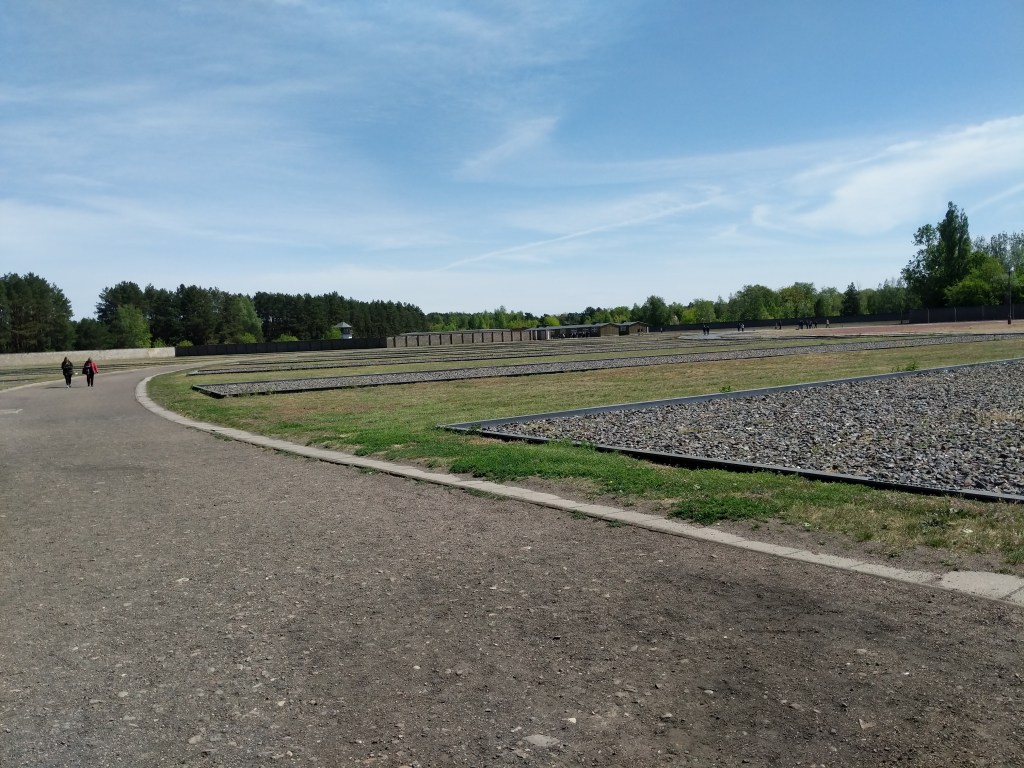
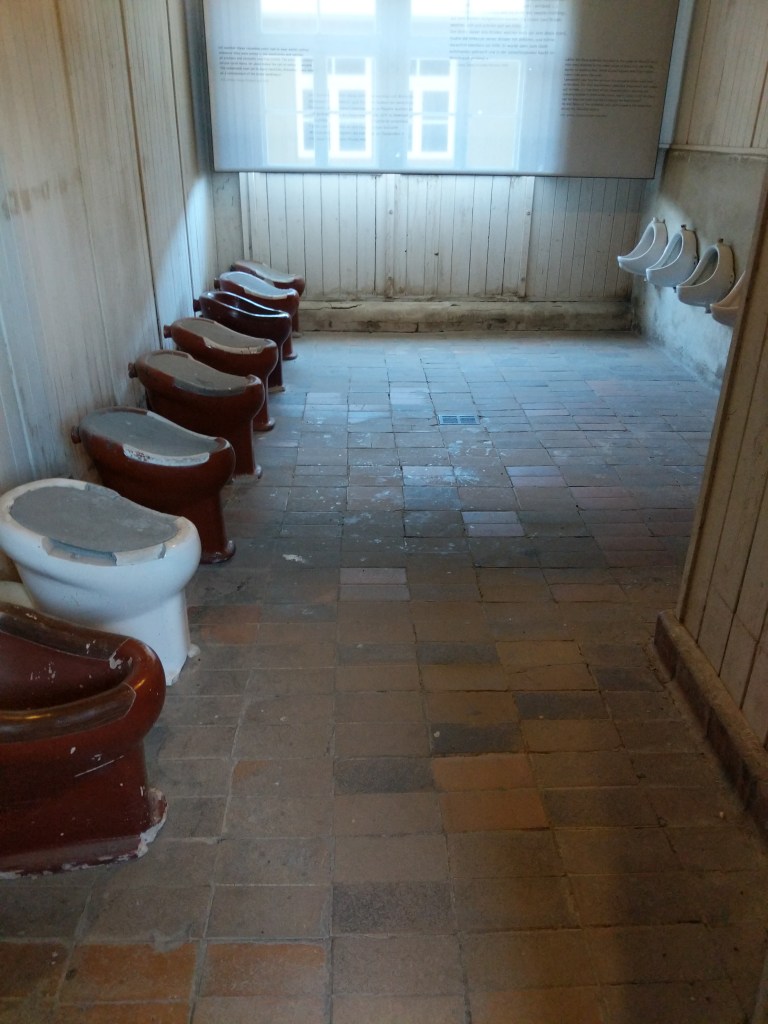
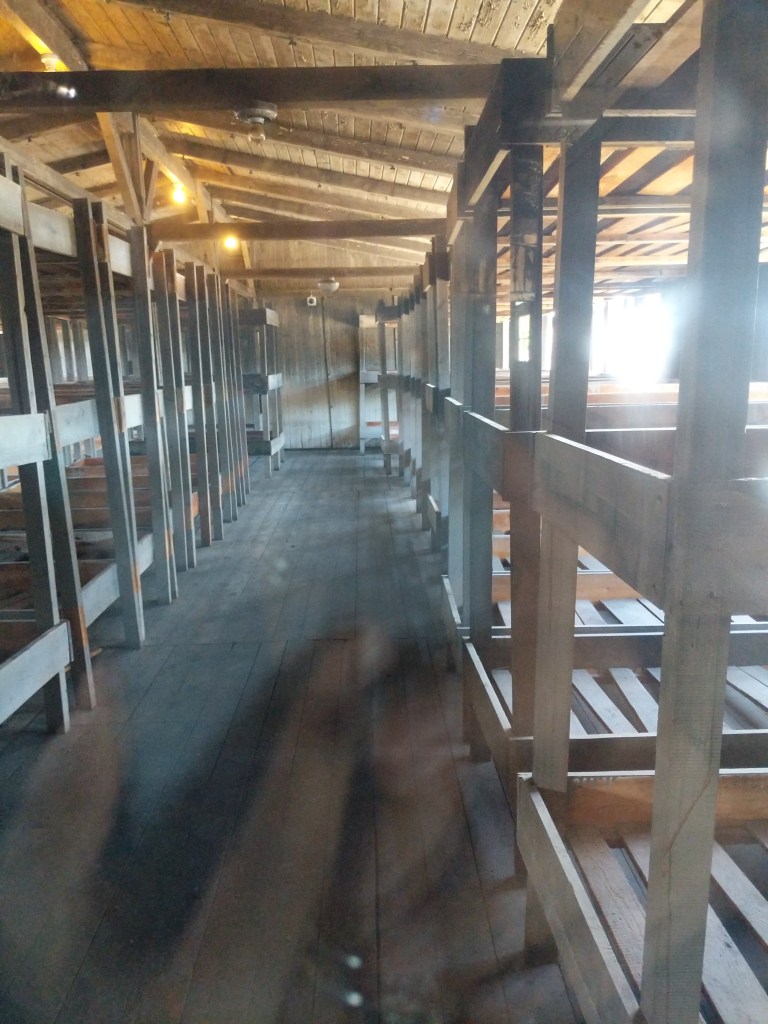
Many of the old barracks no longer exist, but the locations are marked, so we can still imagine what this vast empty plain must have been like. Long low barracks with crowded interiors. Some of the barracks have been preserved/ renovated.
Men and women died here! I walked all around the camp and realised how big it was, the outer left edge had the horrific crematorium and according to my audio guide, human ash could still exist beneath the ground. My god…how many people died for ashes to have accumulated?
How can we be so cruel? The concentration camps were the product of the Nazis, but every human being is capable of being perverted into such masters of death. We have always been capable of infinite cruelty, madness and violence, and the concentration camp was just another reminder of this sad trait of humans. Infact, I could not take it any more. I sat along the distant perimeter wall, on a bench which was windswept and looked back at the camp…and cried.
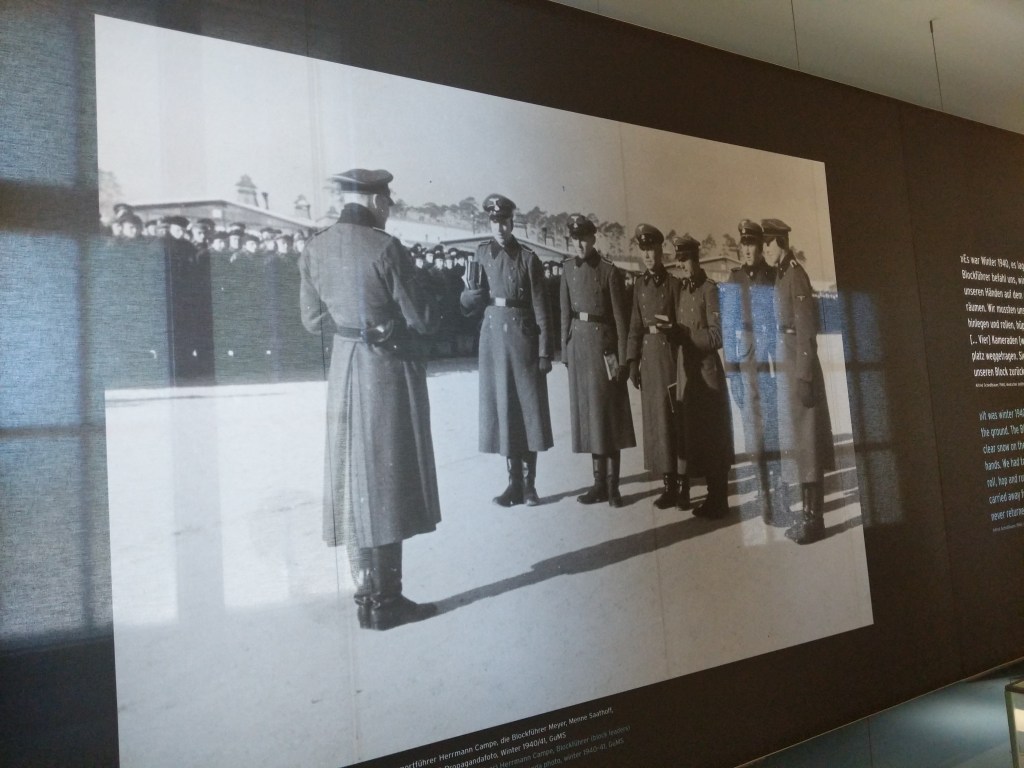
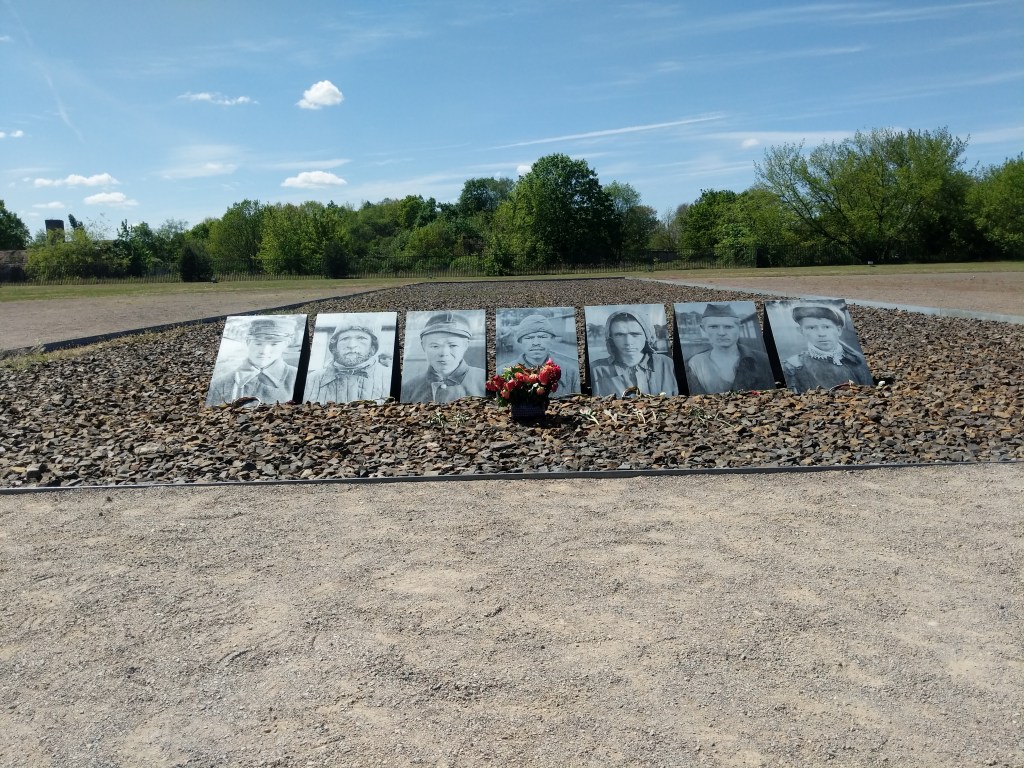
Nazi commander inspects the camps in the winter of 1940/41. They existed, just over 80 years ago, these men walked on the same ground where I did and this did happen..and these men existed too. In fact, they died here…thousands of miles from their homes somewhere in Russia. This reminds me of the Russian infantry’s peasants who died at Austerlitz during the Napoleanic Wars. Travelling all that distance to die in foreign lands. I wonder too of the families these men left behind…perhaps their wives died in Soviet Gulags. What was the point of everything when as they say, the poor will always die for the rich?ashes still lie here…
and i know one thing more, that the Europe of the future cannot exist without commemorating all those, regardless of their nationality, who were killed at that time with complete contempt and hate, who were tortured to death, starved, gassed, incinerated and hanged
Andrzej Szczypiorski
It was a difficult place to visit because it can be so depressing, but if we cannot confront the ugliness in us, then we will never be free.
Ages since I posted! And already as I feared…the memories are fading. For many of these places I had to recheck the names…isn’t that horrible. That all our travels eventually fade and we are left with what we know as the familiar. Perhaps that is better, because some places we know, we simply cannot go back there again. Like Berlin…I don’t know when if ever I will be visiting Germany again.
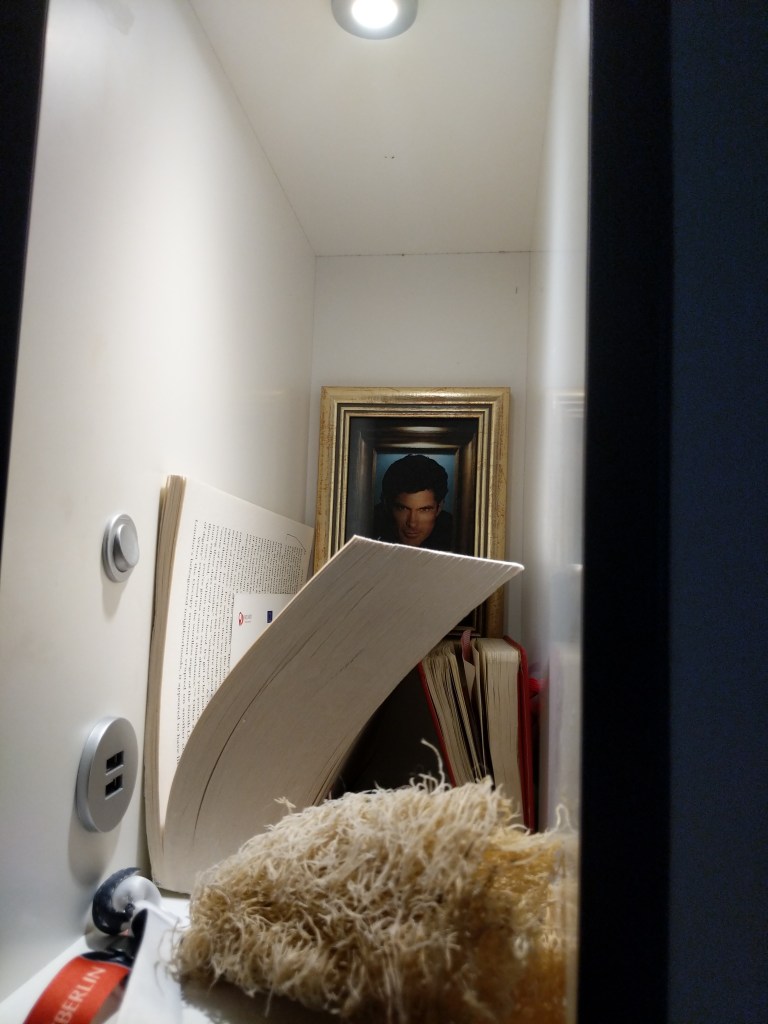
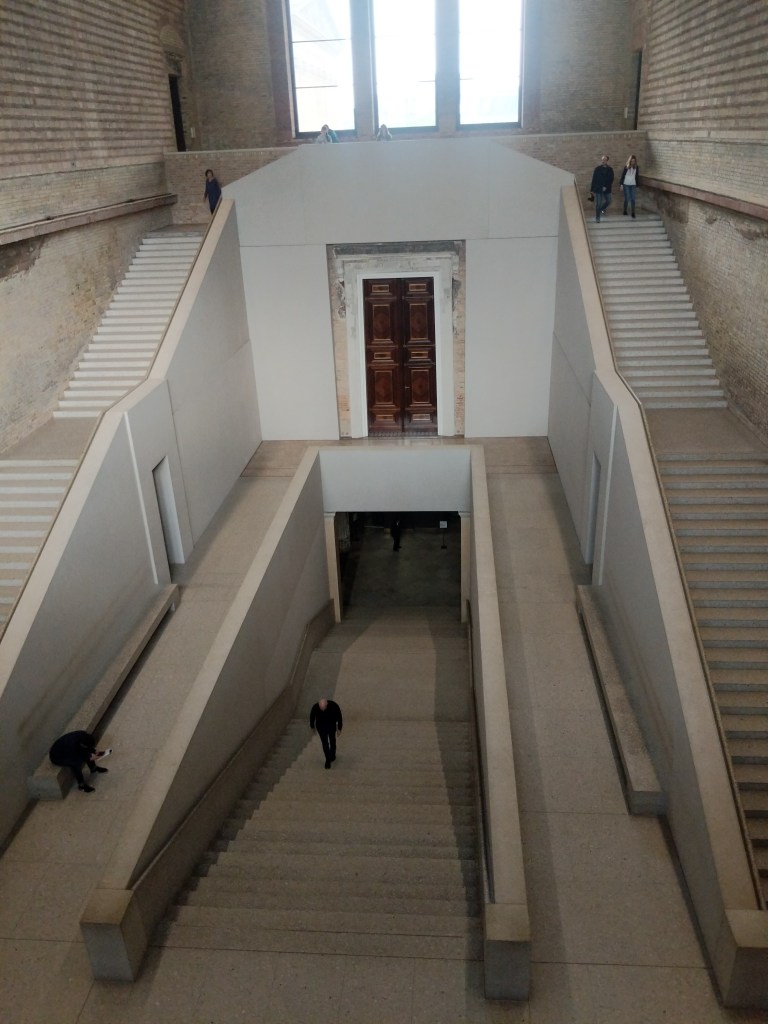
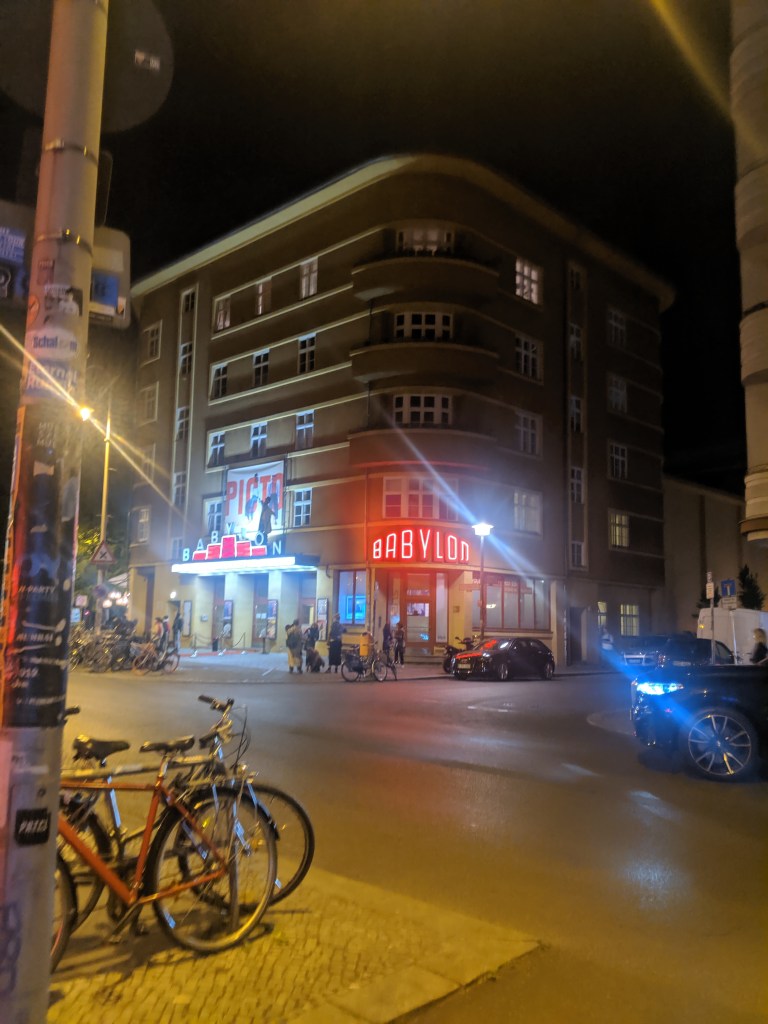
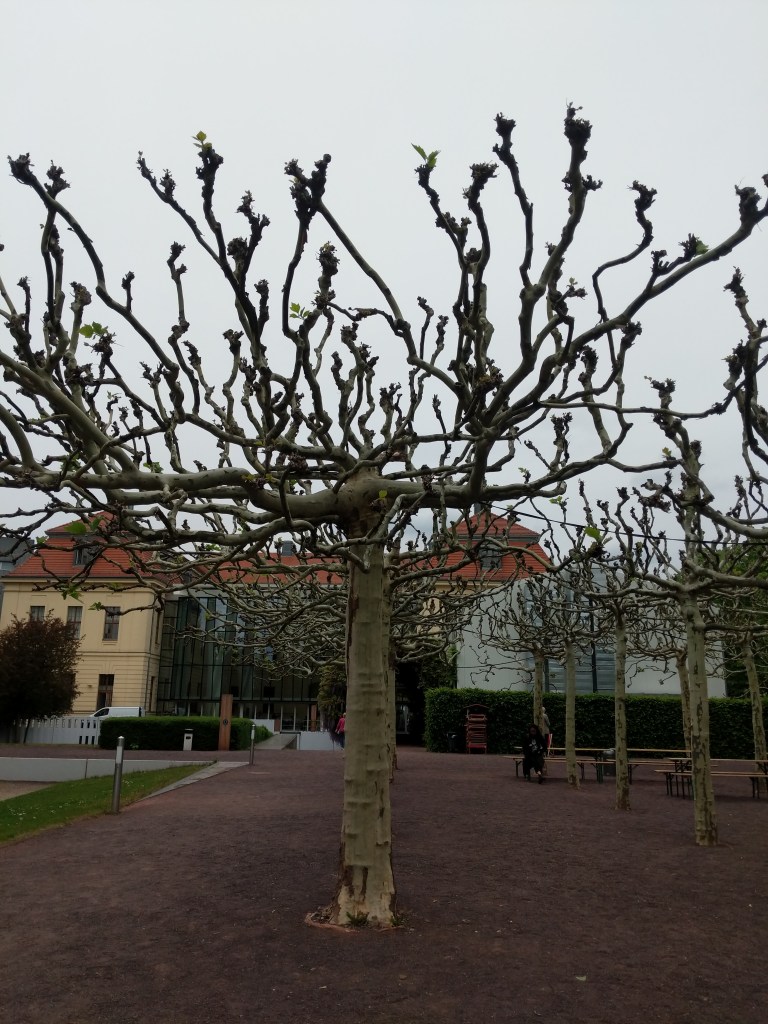
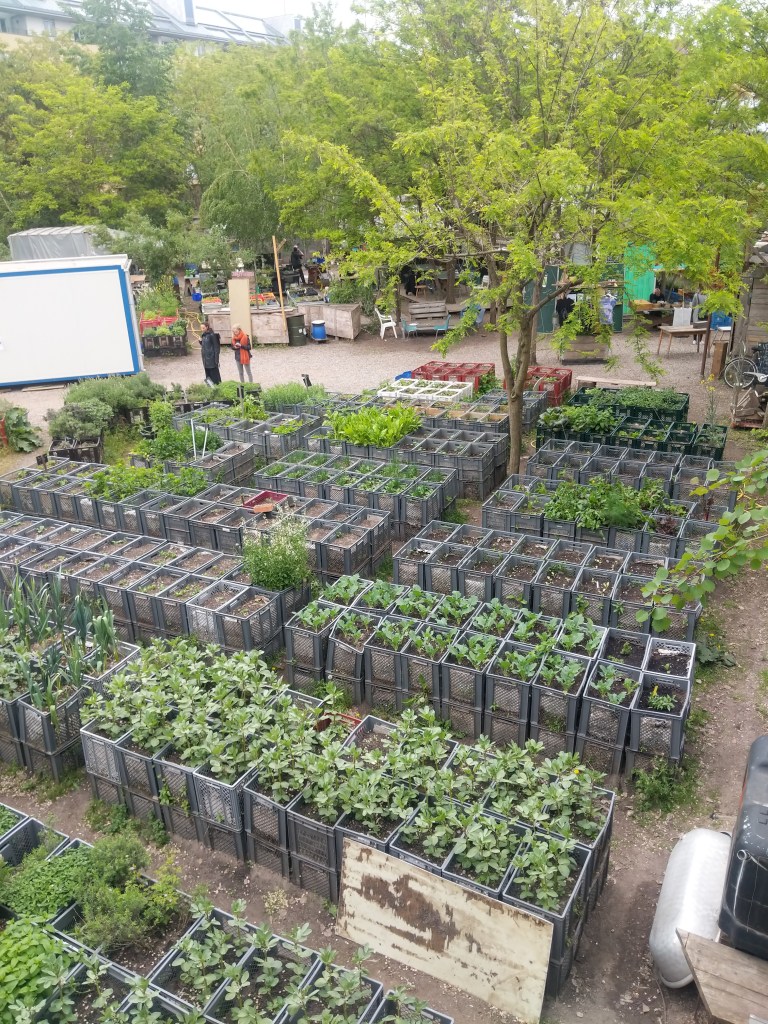
By the time I got to Berlin, I was already in love with the hostel experience. I can’t imagine a more convenient, sharing-economy stay for tourists. The Circus Hostel in Berlin had these cute little wall pods to charge…and yes, that I do believe is David Schwimmer smiling benevolently at me..and my loofah?! Lovely memories of the place, very centrally located.The quirkiness of Berlin…There’s an interesting vibe of a radical, revolutionary young artists in the city that is so refreshing in its un-american-ness, more grubby and questioning, less superficial. This is a city that has kept these vital embers burning. Translation of the German: Blooming for a day without gender, in the toilet at Maxim Gorki TheatreMuseums of Berlin! I spent most of my days in the museums. Got me a museum pass, went to Museum Island and walked like I have never walked before. But also notice the avant-garde (?) , post-modern (?), (probably neither) structural lines at play here? Berlin pushes you to think beyond the conventionalIts single screens! One night I went and watched Golden Glove (Der Goldene Handschuh), a movie that is still sitting somewhere in my head. The tiny screen at Kino Babylon where I watched the movie was (now I discover) a temporary arrangement because of renovations. Nevertheless, a thoroughly enjoyable moment in a cinema that has stayed unchanged from 1929…quite incredible!I think its very important to remember the Jews who were such a vibrant and integral part of German history, especially its urban centres like Berlin. This photo I took in the garden at the Jewish Museum. Unfortunately the permanent exhibition was not accessible, but the axes in the basement, the Garden of Exiles and the Voids were very moving. Also this…Prinzessinnengarten, a community garden in the centre of town. An example again of Berlin’s strong radical left and eco activists. This garden was built and is maintained by the local community on a plot that was a “wasteland”. I think I would have enjoyed this place more if I had company…sometimes I get a bit intimidated by all white spaces..hahaha. Nevertheless, worth a visit!
The featured image is an adaptation of the cover of a book called “Berlin! Berlin! Dispatches from the Weimar Republic” by Kurt Tucholsky. I haven’t read the book, but I read up about the author and his book after I found myself standing under a street sign that said “Tucholsky Strasse”. He sounds like the kind of social-democrat, pacifist, outspoken satirist that I would have looked up to. If we need to draw our political lineages, then it would be to men like Tucholsky.
I am so glad that I decided to add a Potsdam leg to the Berlin trip. I signed up on the Sandeman Tour which was taken by the sweetest guide ever- Georgina was a Scot studying history in Germany, and I always love meeting people who have dedicated their lives to their passion! Berlin is a city that encourages young people to be really dedicated to their passion, it’s quite unlike India where for whatever reasons (well OK…resource pressure! simple economics!) the young are taught to only think about commercial ventures, or enterprises that pay off in cold, hard cash. Anyhow, coming back to Potsdam, the city of emperors.
Potsdam is within the larger-Berlin area, easily accessible on the U-bahn. You only need to get an ABC ticket that allows you to travel in this “Zone C”,and you are set.
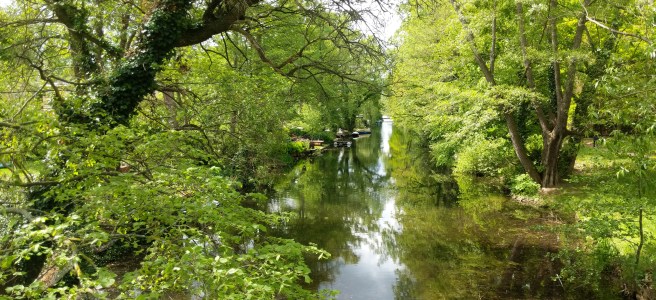
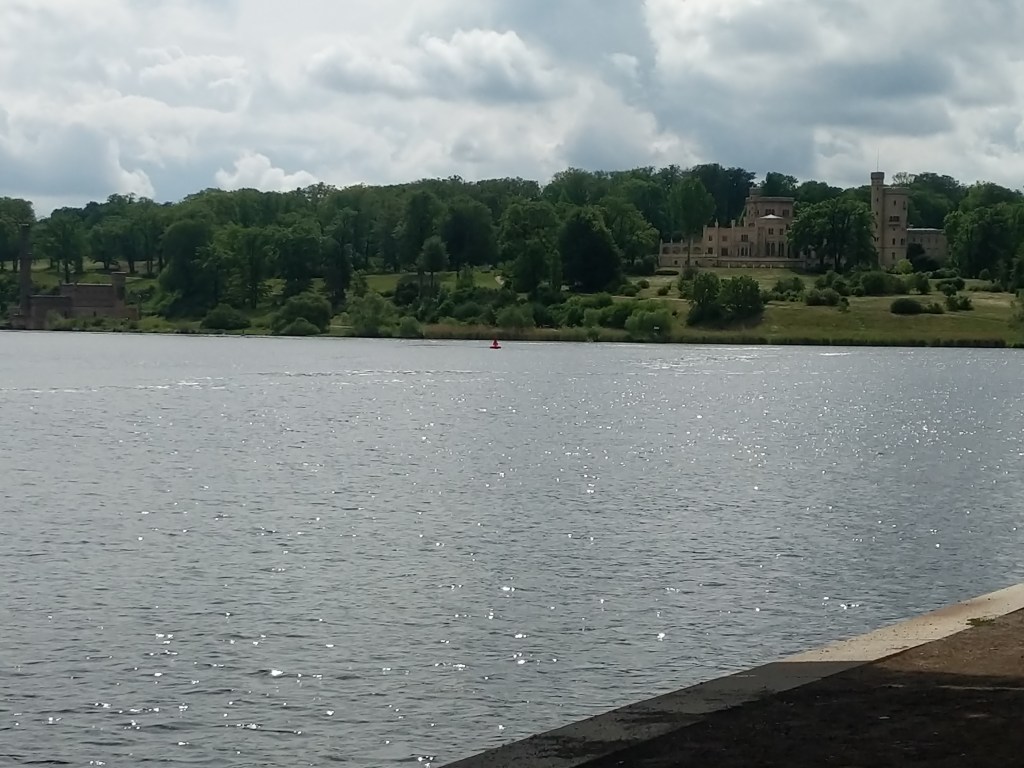
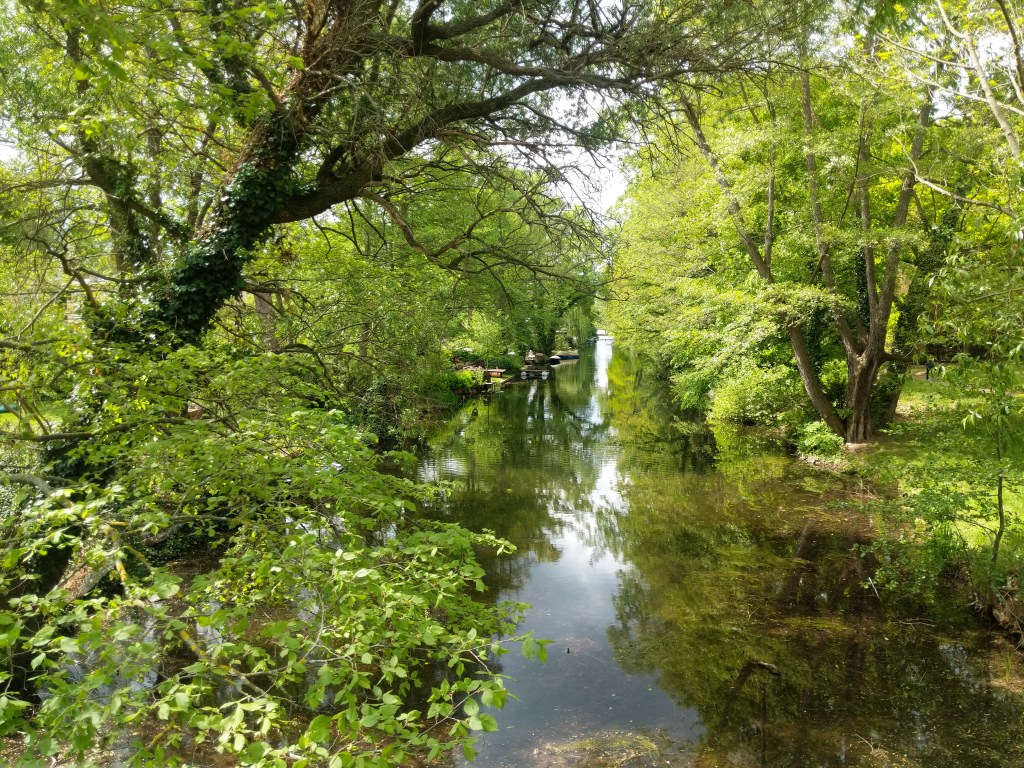
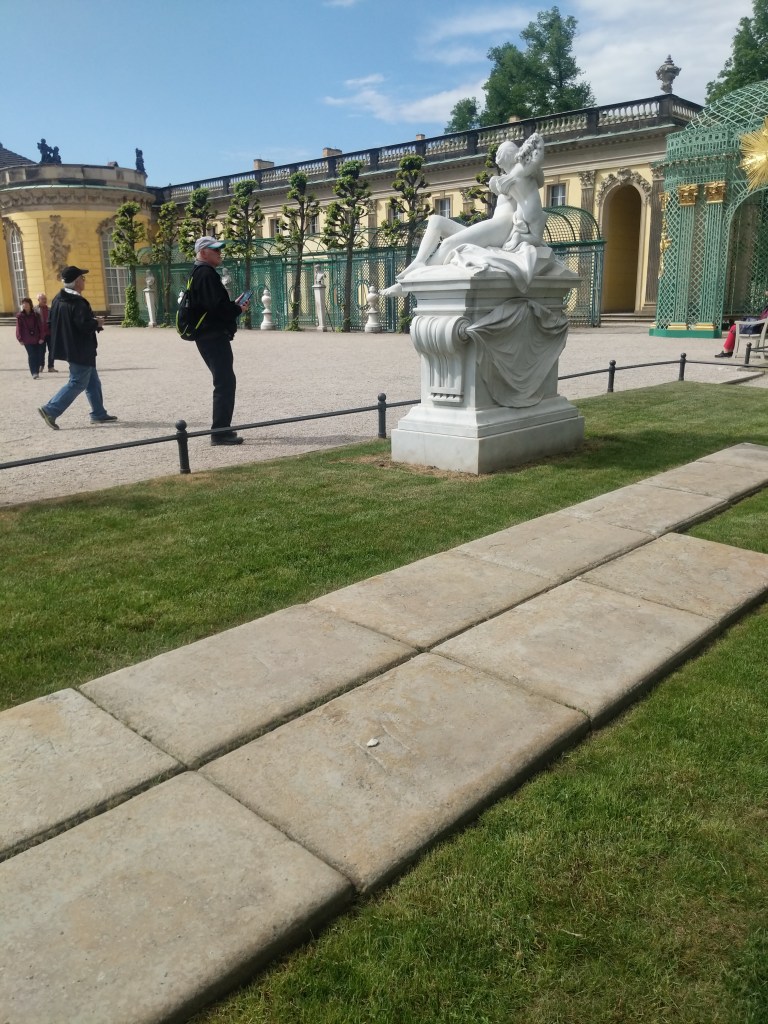
Potsdam was the place where Prussian emperors and the aristocracy lived and played. It’s an enormously beautiful place, wooded walks and vast calm lakes, on the shores of which you can see fairy-tale castles. Every time I look at these photographs I think of the privileged men and women of the Prussian court who once frolicked here. They would have been immensely rich & powerful for their times, living away from the peasantry, surrounded by beauty. It’s truly like walking into a painting, like visualising the vast estates of Tolstoyian aristocrats, a beautiful dream-like state.
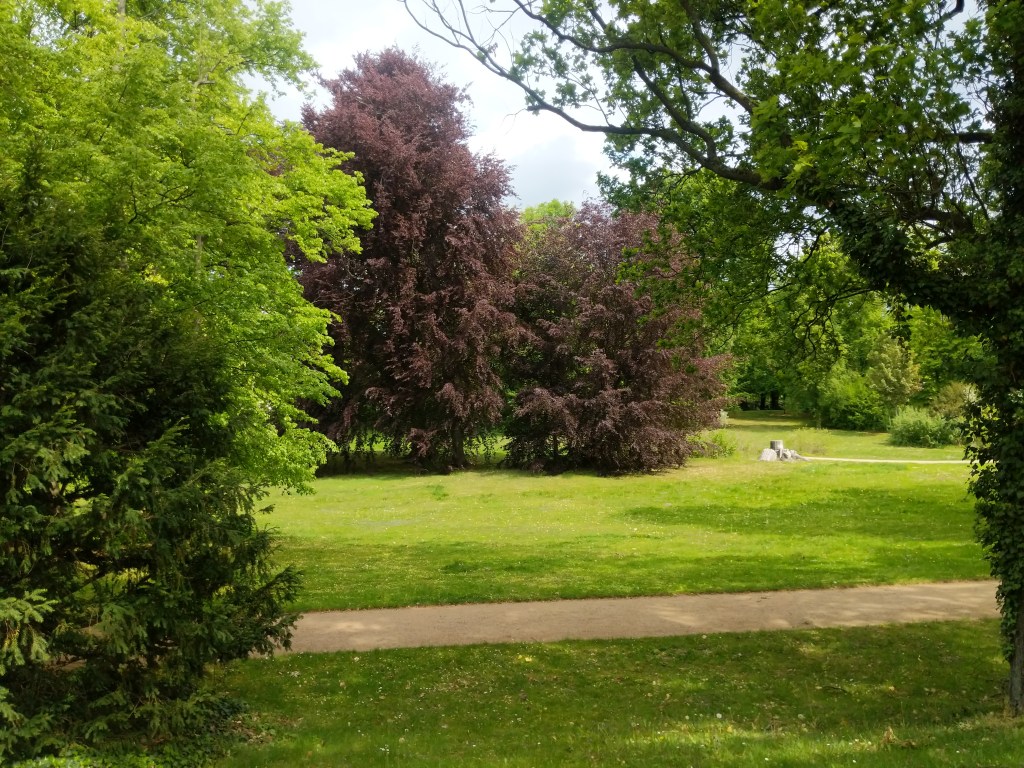
I can’t remember the name of the landscape artist who designed the parks we walked through, I am quite sure Georgina told us, but I do remember her telling us that he purposely designed the parkways to look untamed. In reality, he was guiding the visitor through every vista. One can literally stop and see a perfectly framed landscape, utterly delicious, Germanic precision with French abandon!
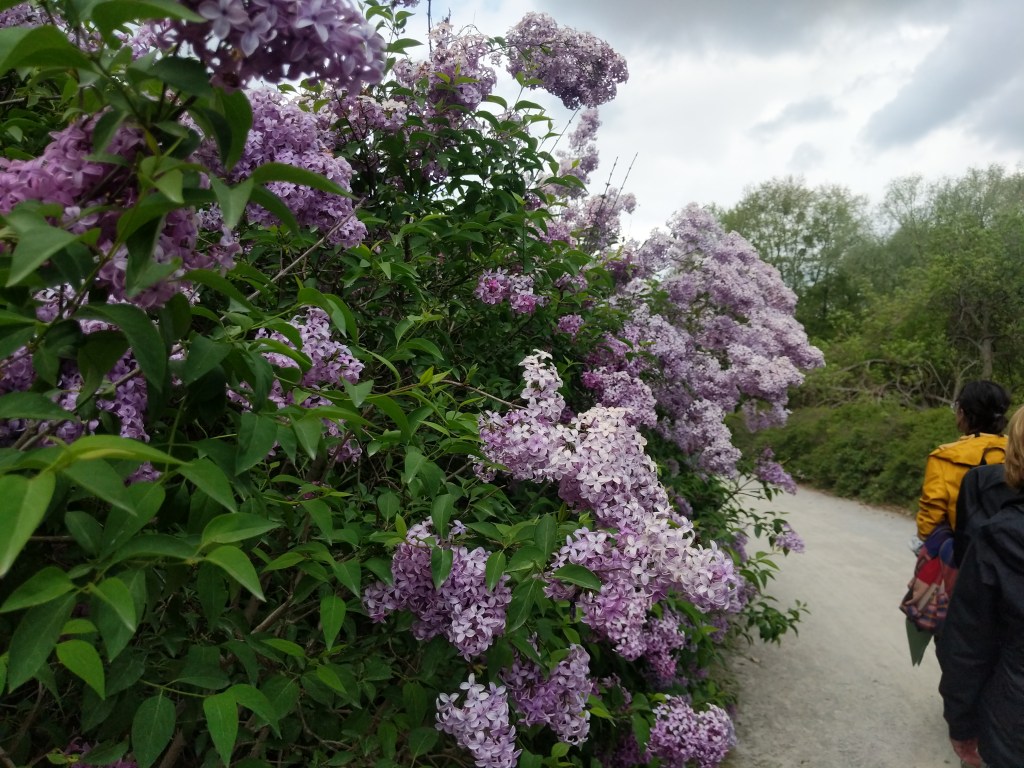
When I saw that enormous bush of chrysanthemums, I was reminded of Darjeeling. The flowers grow wild in the hill-town, but are sadly neglected. Like everything once-beautiful, we have just let things go to waste. It’s the curse of India, the fact that we entrust crown jewels in the hands of veritable carpet-baggers, like watching an exotic beauty crumble in old age.
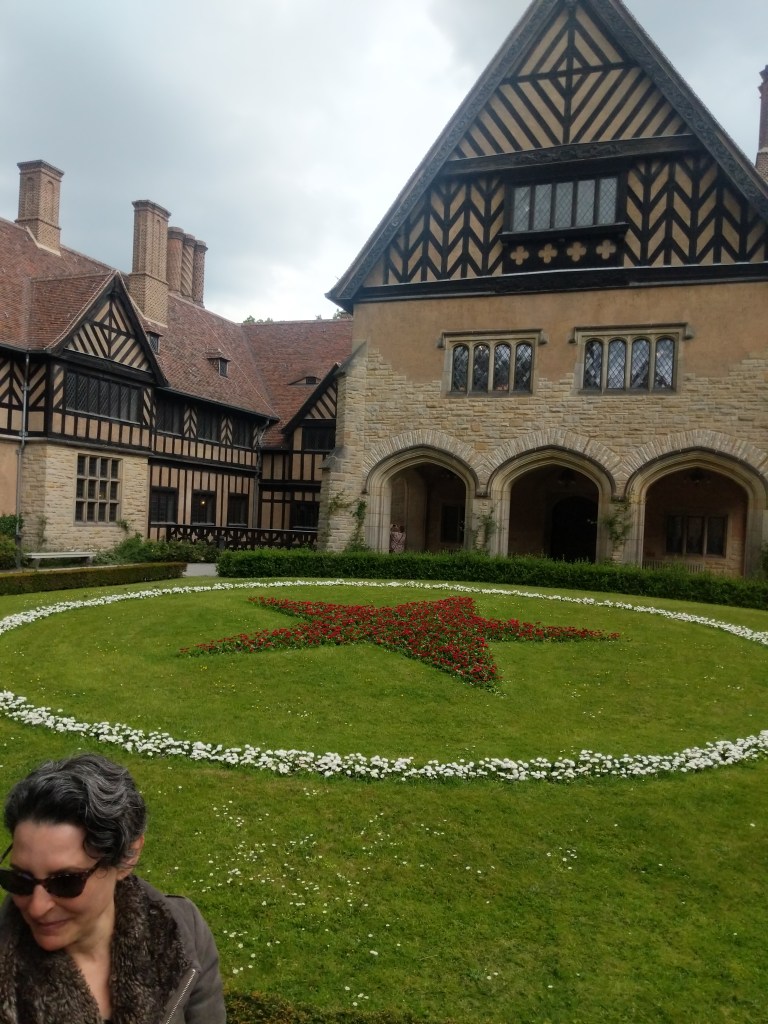
Only when we reached Cecilienhof did I realise that this unassuming place was the site of the historic Potsdam Conference. That explained the communist star dominating the entrance! Sometimes when I encounter historic sites I feel a sense of disorientation- at how the world changes, how we are just a passing breeze, how we age, how we will all die…a little shudder always passes through me. And then I think about how little time we have, and how we must never waste the opportunities we have, or take in the beauty around us.
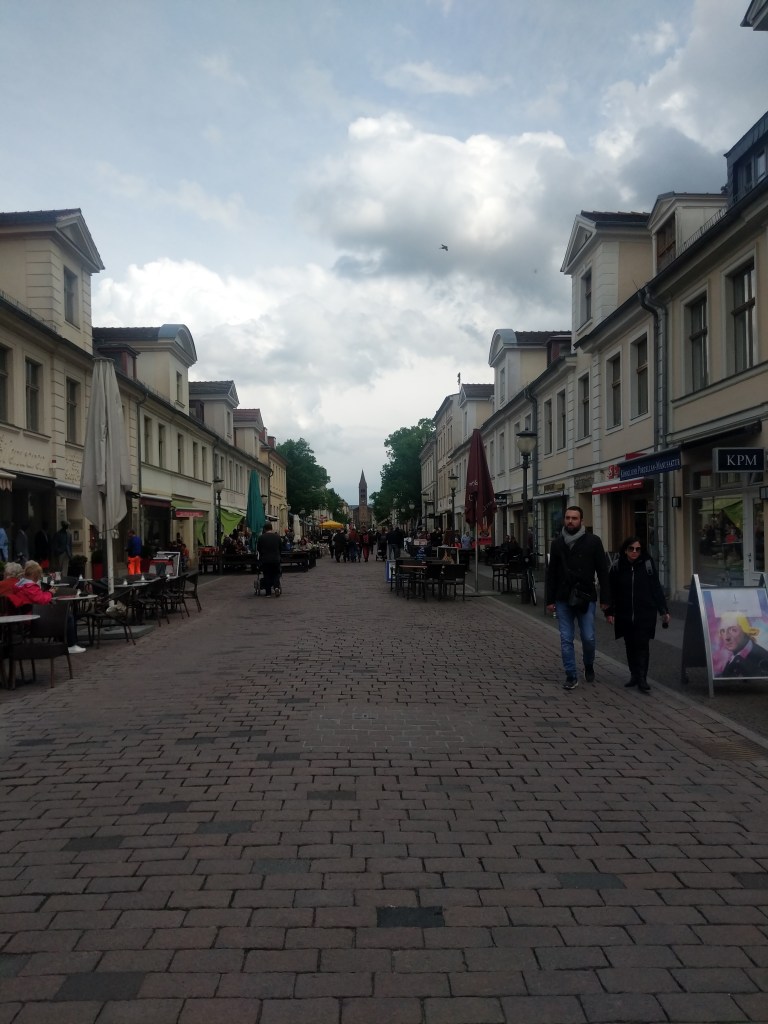
Nearer lunch, the tour took us through the centre of town. Our guide showed us a cafe where dissenting artists during the cold war used to meet, and again that blew my mind. Humanity has always had tyranny, undoubtedly the one we see in India today is just the beginning of a few years of darkness. However, there are always these little forces of rebellion bubbling far beneath the surface. Tyranny has never succeeded in completely crushing the human spirit, perhaps it crushes the individual, but never the spirit. Every new generation is an act of rebellion I think, and one day, they will remember us yet.
View of the town of Potsdam. I remember that doner kebab quite fondly! I was famished after the long walk, and this was my first doner ever. It was difficult to bite into something as enormous as this, I think South Asians in general eat much smaller helpings. But once done, it was the most satisfying lunch 🙂
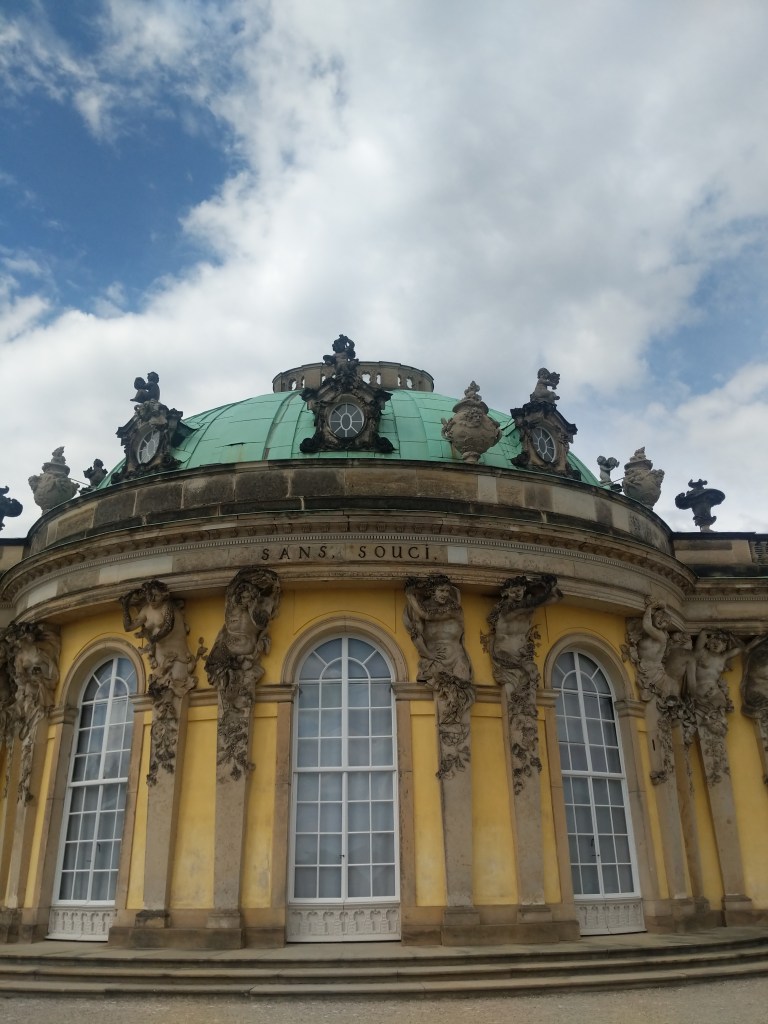
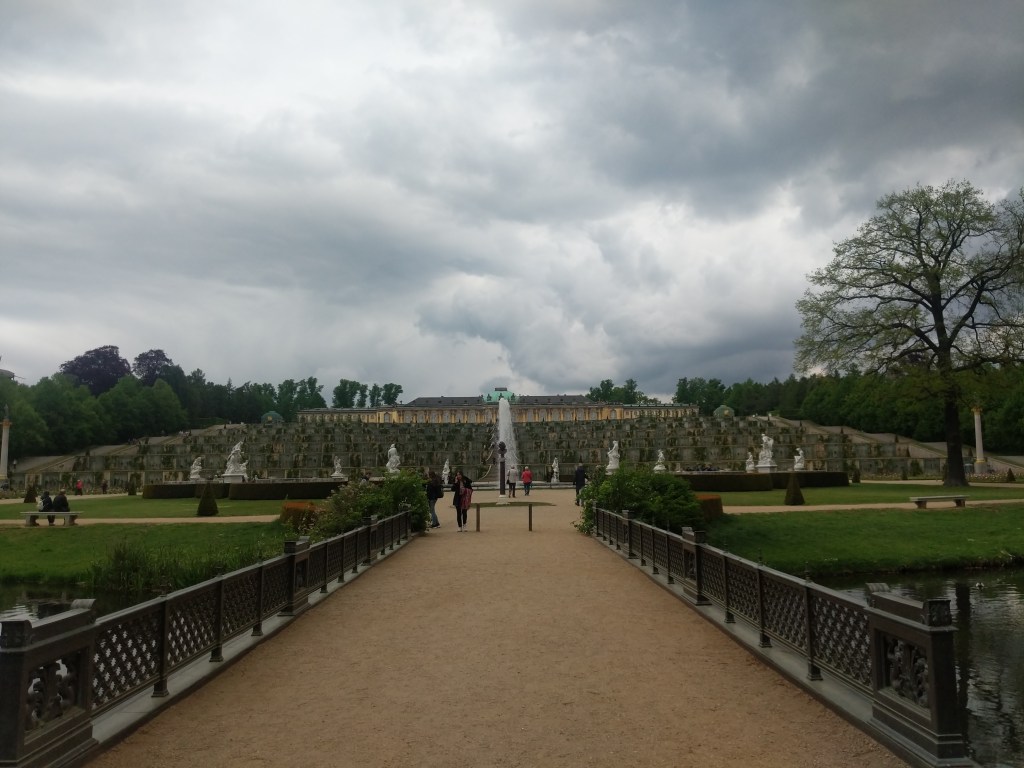
After lunch we made our way towards Sans Souci, the beautiful palace of Frederick the Great. Georgina did a great job of walking us through the many Fredericks (or more precisely Friedrichs) in Prussian history, and after her tale of Frederick the Great, I was completely enthralled by this emperor. European history for me is largely through an Anglo-Saxon post-colonial cultural filter. Perhaps he was fleetingly mentioned when we read a bit about Bismarck in school. I think what touched me most was the story of his teenage crush (?) and subsequent escape with his tutor. Frederick’s father (also a Frederick) was a tough man who didn’t like the softer side of life, and when his prodigal son was brought back, Frederick Sr. had the tutor executed while the son watched. Ironically, Frederick Jr. saw more military action than his father ever did, expanding and strengthening the Prussian empire; however his heart was still artistic. At any moment he could, he used to escape into the beauty of Potsdam and to his palace that he called…Sans Souci, in French“without a care“.
It was slightly unfortunate that in 2019, May was quite chilly. Apparently in summer, those tiered steps towards the palace are covered with fruit-bearing plants, vines, greenery, flowers, sunshine. What a beautiful place for an emperor to rest
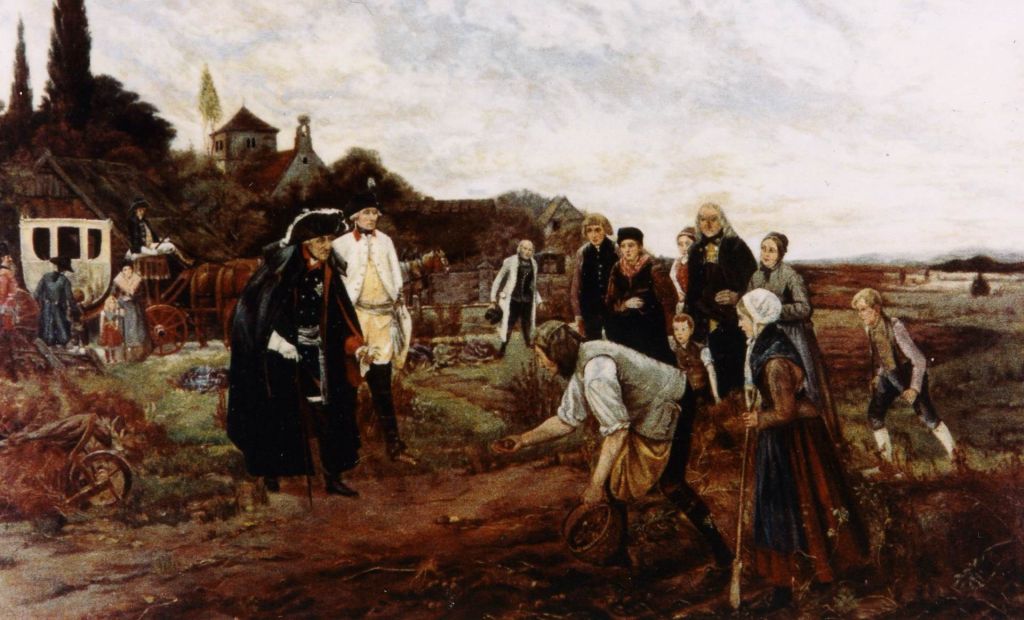
I also found out that the old emperor was often called the “Potato King”. Apparently he was the one who introduced the very important tuber into German diet. When he initially faced inertia from the farmers to take up planting this strange vegetable from South America, the emperor came upon a plan. He pretended that this was a super secret project that only the emperor could plant, and had guards watching over the fields every day. But in the night, he made sure that the security was much more lax. In a classic case of behavioural nudging, he got the peasants to be really interested in this strange spud, and so after a couple of midnight pilfering the peasants began to take to potato.
“The King is everywhere” by Robert Warthmueller, a painting I especially loved because it seems to capture that unique hold that Frederik the Great has over the German people, a genuine love and respect. At the same time, the emperor meets the people without hauteur, he is bent and frail and looks deeply touched by the simple offering of a single potato
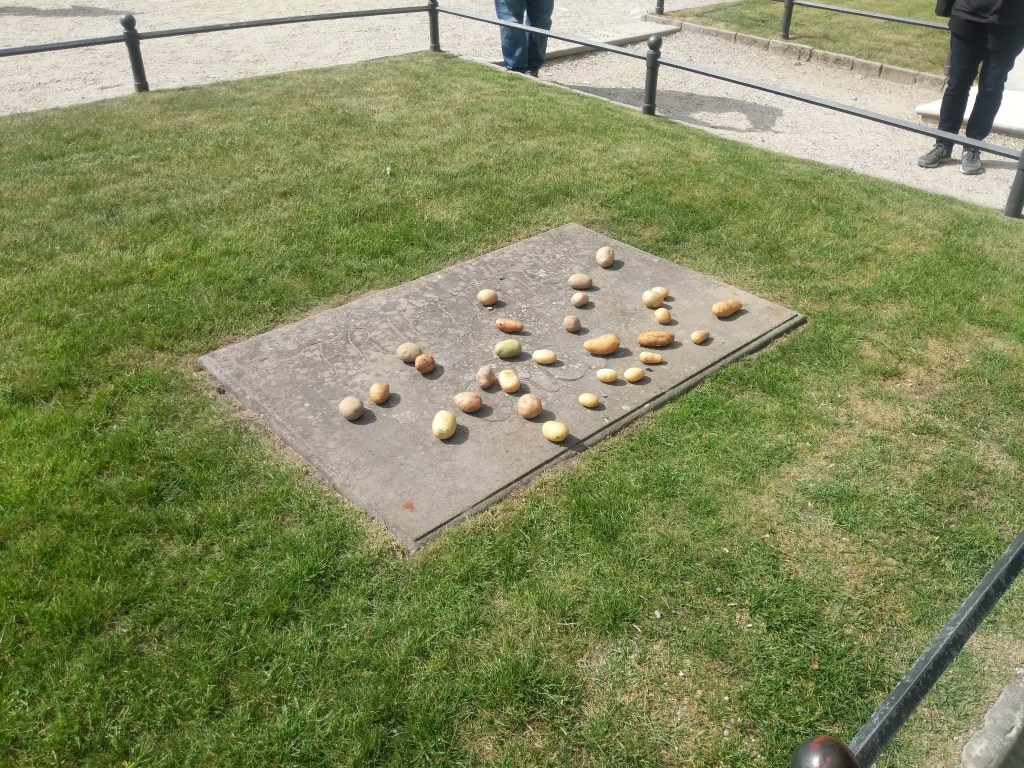
The tour ended on a sweet note after I asked the guide about the seven or so slabs of stone, and the potatoes strewn one of those. This was Frederick the Great’s grave, here lay the great Prussia, surrounded by the graves of his favourite dogs. The potatoes were what people brought when they visited the Potato King. I must recommend you to take some too, and please take one from me, because I didn’t know about this custom until too late.
How do we mourn the ones we lose to tyranny? The lives that were so short and compressed. Germany has gone through some of the worst excesses, but unlike many other places, they have also memorialised the past. I believe that a society’s ability to remember and acknowledge the victims of the past is a necessary stage towards forgiveness and growth. Otherwise, like that oft-repeated but true phrase goes “those who forget history are condemned to repeat it“.
After my guided tour of the Berlin gate and other better known sites, I walked alone through the Tiergarten that is nearby. This garden is expansive, and probably deserves a day of its own. As I skimmed the periphery, I came across a small clearing and there stood the Memorial to Homosexuals persecuted under Nazism. The memorial is a large block of stone with a small “window” cut in one side through which you could look in. Inside, I could see on continuous loop, a video of two men kissing. If you come from eastern cultures, you rarely get to see couple hugging, so there’s always an element of novelty when I see couples kissing or displaying public intimacy. That is why I would recommend everyone from different cultures and upbringing to go and see this, because we need to get over our initial reactions, whether it is to see a man and a woman kiss, or two people of the same gender get intimate. We are all the result of our past, but we have the ability to change the direction of our future. We can all exercise the ability to expand the boundaries of our minds.
This video of the actual memorial is by Stefan Ourakcha. Interestingly the video I took (and which I can’t upload it seems) has a different set of men kissing. So maybe the content is changed occasionally. I believe there is also a proposal to show women kissing.
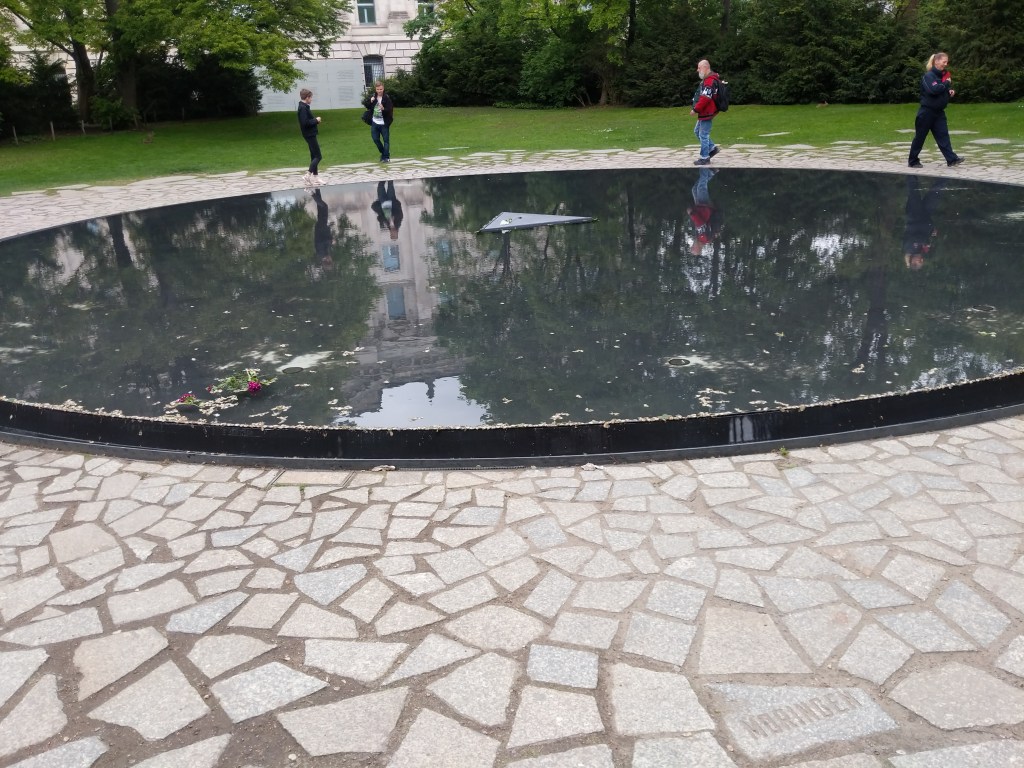
In the same garden I also came across another quiet memorial. This was the Memorial for the Sinti and Roma people, the gypsies of Europe. These interesting community have some obvious and distant connections to our own banjaras (gypsies of western India) and have always fascinated me, especially when I come across linguistic similarities. Here’s a video I watched a long ago, featuring a young Romani woman walking through the bazaars of Delhi.
Can you imagine her people when they first arrived in medieval Europe? Gypsies/ the Romani, Dom & Sinti people have a long and over-looked history of being victim to atrocities, typical of what befalls the poor and the weak. Video from IBNlive.comThe memorial is a beautiful and dark pond surrounded by flags of stones, on which the names of concentration camps have been etched. A poem by a Romani poet Santino Spinelli, is written on the outer boundary of the pond-“Gaunt face / dead eyes / cold lips / quiet / a broken heart / out of breath / without words / no tears”
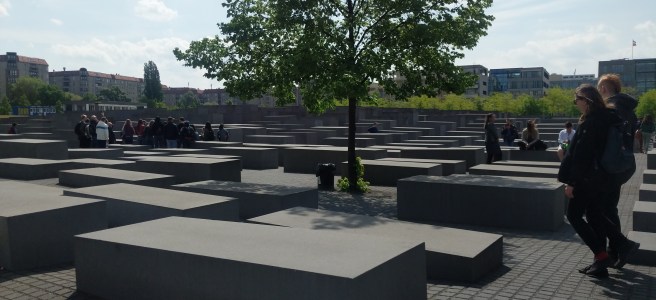
Earlier in the day, the tour had taken us to yet another tragic memorial, the Memorial to the Murdered Jewsof Europe, and that of course has to be one of the lasting scars in the history of the world. The memorial is a block of large granite stones that reminded me of tombs, hundred of them stretched out. A forest of darkness through which our tour-guide let us walk in silence. Afterwards, when we came out on the other side, we were asked to describe what we felt. That was a powerful experience that I think I should not put into words, and let it remain somewhere inside me.
walking through the Memorial to the Murdered Jews amplifies your contemplation of the holocaust through visual and tactile stimuli.
In the course of visiting all these memorials, it struck me that each of these had been planned with deep thought. This ability to think through the objective of the memorial is in itself a testament of the respect shown to the dead. These memorials were built to evoke emotions, context and experience in us who come many years after these tragic deaths. Needless to say, I am simply blown by the scope and scale of such acts of remembrance, especially the individual efforts, like the stolperstein.
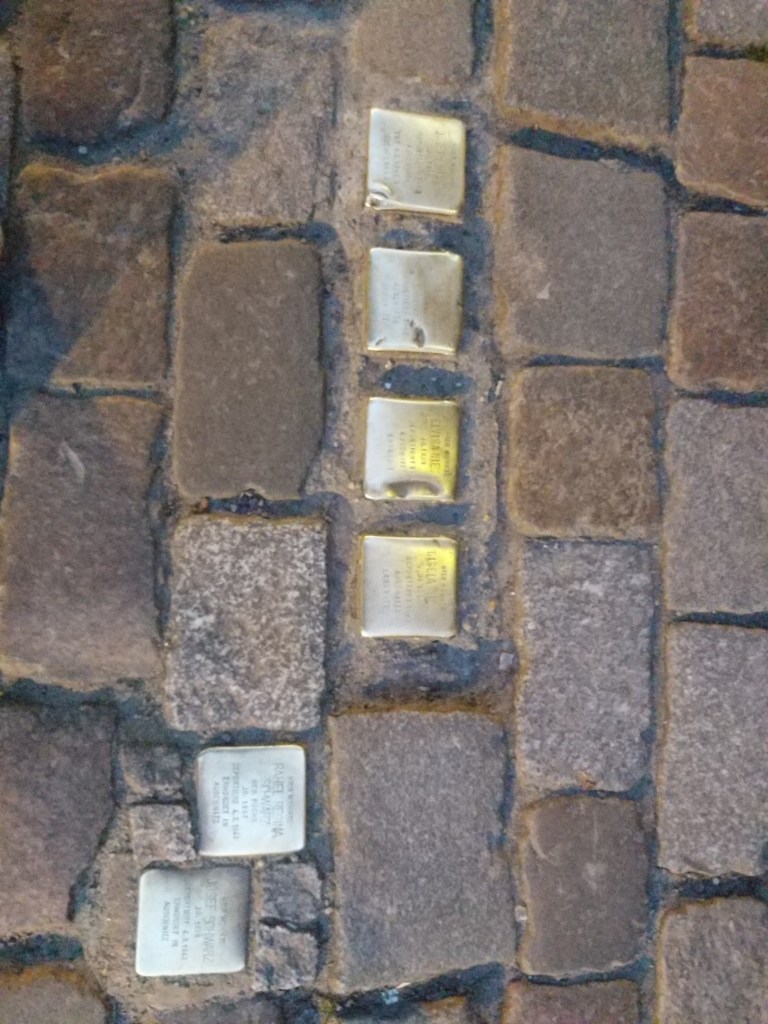
On one of my night-outs (with another desi that I met), I inadvertently found myself standing next to a set of stolperstein. I had spent days looking down while walking, looking out for these little bronze plaques and never coming across one; and yet, here I was, looking for some dinky club, stopping to take a breath..and right at my feet were these bronze embellishments. The stolperstein are the work of a German artist Gunter Demnig. Each hand-made plaque bears the name of a Jewish resident of the town. The stones record the year and place of birth, as well as the final destination… in all cases, the death camps. Local communities are actively involved in researching the names of the Jewish residents and an application is made to produce the little plaques. A few months later, these are lovingly set into the pavement, outside the homes and old offices of the victims.
Stolperstein for the Schwartz family, and I think, the Nielsen families, all six perished in Auschwitz.. Apologies for the very bad quality of the photo. I still shudder when I think..imagine, taken from this threshold, all the way to Poland to die?!
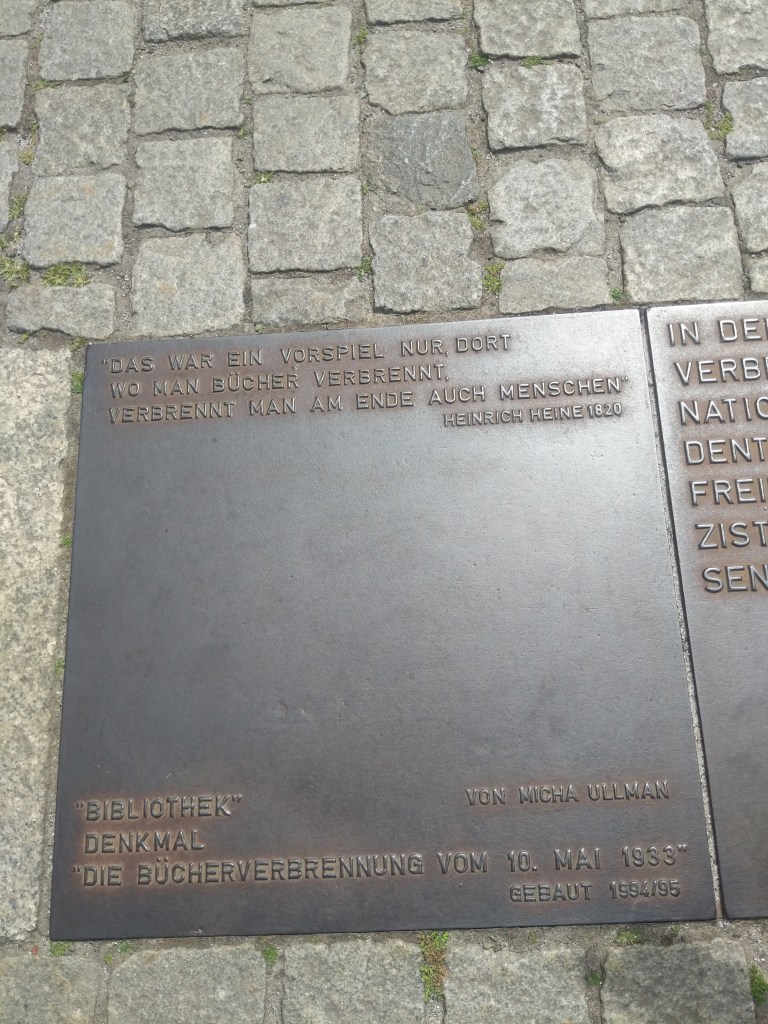
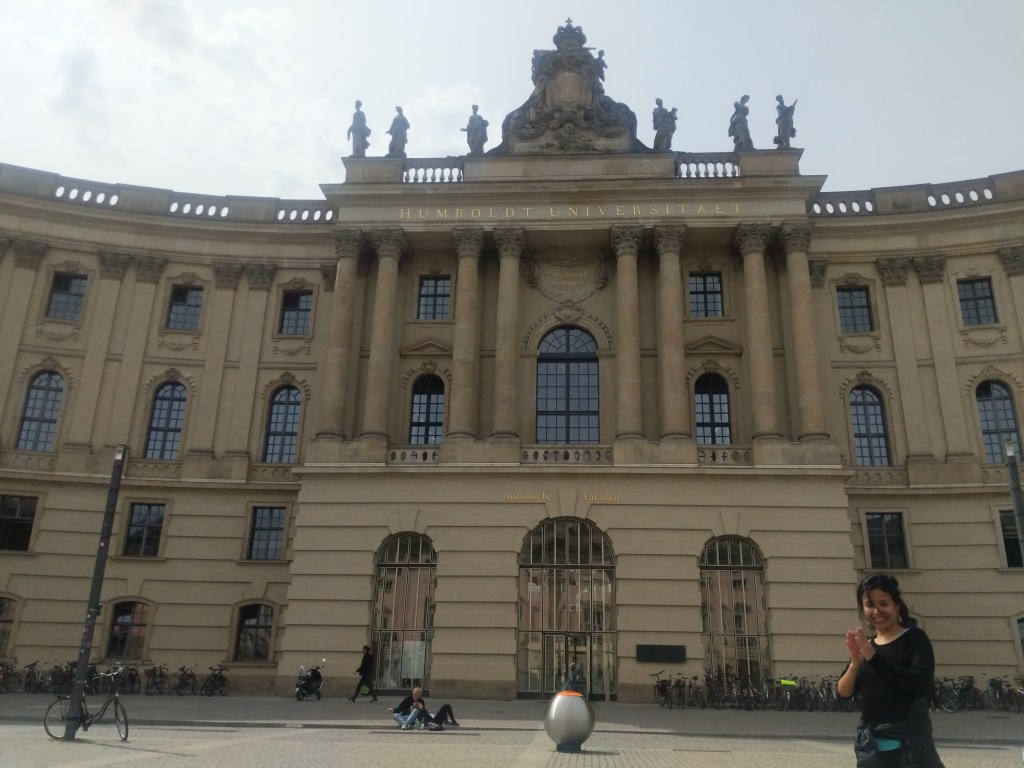
Finally, as a book lover and also a product of a most open education, I remember the plaza where the Nazis had a massive book burning. The irony is that these “ultra nationalists” destroyed potent symbols of knowledge right in front of the Humboldt University, in a square that is flanked by buildings from Germany’s own enlightened past.
This is the irony or perhaps the truth of the far-right ideologues, often they have little sense of the true greatness of their cultures and instead they represent the most narrow (and violent) tendencies of the primal human. As I stood over the glass pane that now covers symbolically empty book-shelves, I was thinking of the countless acts of violence back in India, the various artists we have hounded out of the country, the voices that have been silenced, the youth that has been stifled. It is the curse of our human existence that we will always co-exist with the Cain of our species.
“Where they burn books, they will, in the end also burn people”- Heinrich Heine
My ancestors were from a part of the world that had been sheltered from everything that most people would know as world history. Even if consequences did reach them, it would be days, even years after the passing of an event. That is until the late ’50s, when the modern era broke into the lives of people living in the lee-ward side of the Himalayan range.
Once it did, the modern era was probably too much to take in for my great-grandparents. My grandparents stumbled through it, my mother eventually found her footing while we have been feeding from a steady drip of exposure to western perspectives. In the last few years, an explosion of perspectives has enveloped us, and sometimes we are washed onto distant shores, muttering quae regio quae mundi plaga? And yet, even in the confusion of all the commentary on the world, the invisible string of the puppeteer is faintly visible, but again I seem to digress.
To get back to my trip, I loved Berlin because I am fascinated by places that are steeped in history. We have places like that in India too, but here we have a fatalistic and tragic truth…we bulldoze over our past. We tear down the walls or we let it sink into obscurity. We believe that if we raze down structures and rebuild pastiche over it, we have made our history even better. Additionally we have displacements of humanity by the millions. That always reminds me of the stray dogs.
The story of the stray dogsof Delhi
This used to happen a few years ago and has thankfully become less noticeable of late. Every few months, an animal sterilisation van used to round up the stray dogs on our street. After a few days the van would come round again, and release dogs back on the street. For a few days you would see hungry or scared looking dogs sniffing around, jumpy and anxious. Vicious fights would break between them and always the weakest would run across the street, tail between its legs and howling into the night. So frightened that it would smash against grills and thorny bushes, trying to get away, anywhere. This was very strange behaviour from dogs that had been born and brought up in these streets.
Only when we got closer to these poor confused animals did we realise that..these dogs were different from the original residents. The sterilisation van was callously mixing up where they picked up the animals from. Everything was one big chaotic operation and the boys in the van were probably completing their daily quotas, 10 dogs to pick up and 15 to drop back, plus dog-bites, chasing the animals down, stomachs to feed all for a few hundred rupees.
This was what is happening to the dogs, people and history every day in the poorer parts of the world. We are not even sure that we will die in the same city where we were born.
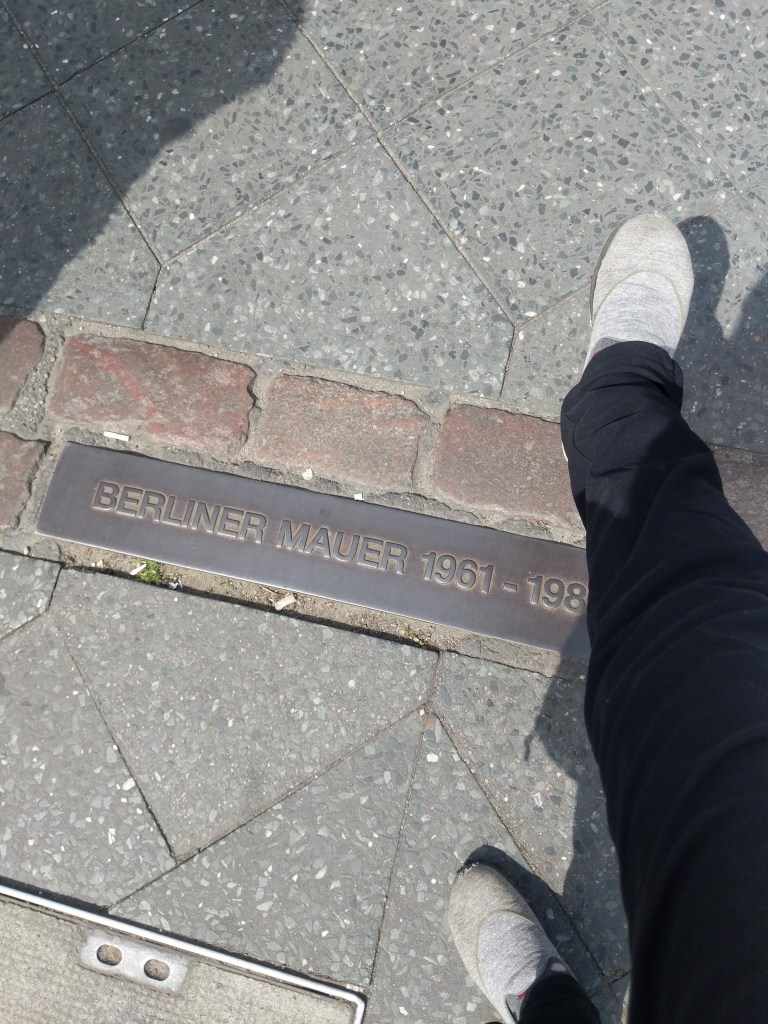
Today we walk so casually across the “wall”. But over fifty years ago it stood like an impossible end of all dreams for so many Berliners.
Back in Berlin…
Forgetting who lived here and why, that has not happened in Berlin, and rightly so. As they say, if you do not learn from your past, then you are destined to repeat it.
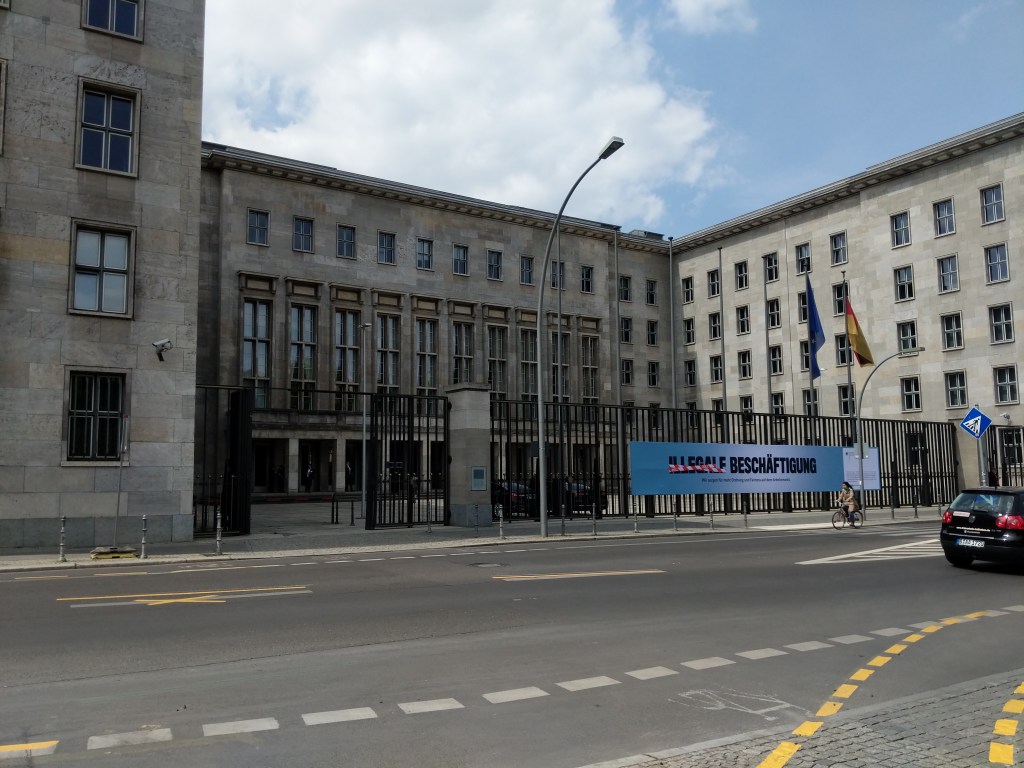
The Detlev Rohwedderhaus was the centre of Reich Aviation Ministry and was “Goring’s centre of power”. During the Soviet era, the building continued as part of the military administration. Today the building has been converted into the German Finance Ministry.
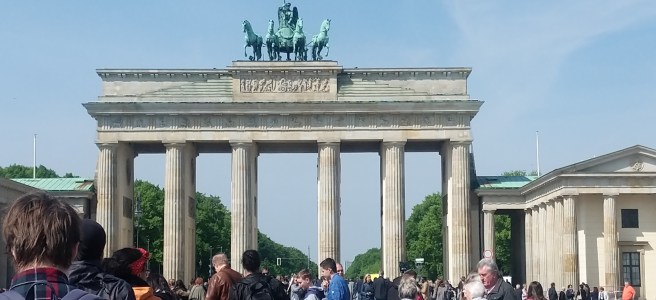
In Berlin, I took the Sandeman tour on the first day, just to orient myself. I could have walked to Brandenburg Gate, but the U-bahn connects very well, stopping at historic stations whose names I think I still remember (in random order) Oranienberg, Rosenthaler Platz, Friedrichstrasse etc etc. Every station name made me google its history and some of it was sobering- old Jewish quarters, or the names of brilliant people with tragic lives.
Somewhere under this carpark is Hitler’s bunker. The bunker was flooded with water and buried under earth. Some things you really do not want to preserve.
Whenever I walk around a historic part of a city, I always imagine a person born at the beginning of a period, say just near the end of the war. I imagine all the experiences that the person would have gone through in his or her lifetime. Perhaps as she went through life, she did not recognise the momentous events for what it was. She would live every day, every week and year like the rest of us, until one day she was old. Only then would she realise the phases of history that she had gone through. Was her father a Nazi? Was her husband a spy? Did her son make it to the other side of the wall? Where was she when the wall fell? How old was she when it went up? Did she die in unified Germany?
Here I am, super excited to see the Humboldt University facade. Humboldt was a familiar name to me, the explorer and early scientist, whose South American travels was so vividly covered in one of my first National Geographic magazines. So this was like meeting a familiar person in an unfamiliar land. ha ha!
It was fascinating to learn on the tour that many parts of Berlin were rebuilt after WWII, and that people were given a choice- did they want absolutely new structures, or did they want buildings similar to what they had before? I am glad that they chose to mostly rebuild their city. No matter how far below they sank, the German people chose to rebuild, removing the stains and trying to retain the great ideas that some of its true luminaries had.
Before my visit, Berlin, and indeed all of Germany, was stained by Hitler. This trip helped to understand a lot more about German history and the far-reaching consequences of every event that a country can go through.
Even more interesting was to see how quickly people’s lives could change and adapt to the most displacing external shocks. Truly fascinating, our human history.
Modern Berlin is radical, underground and hopefully always going to encourage her visitors to always strive for the frontiers of human freedom