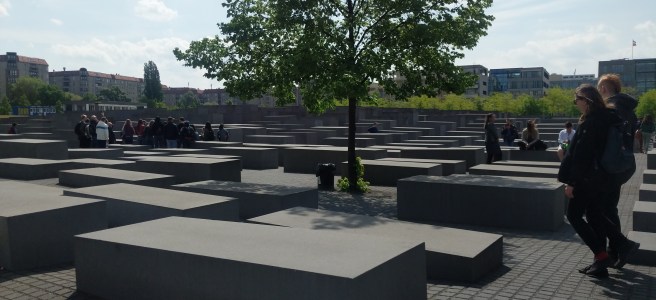
How do we mourn the ones we lose to tyranny? The lives that were so short and compressed. Germany has gone through some of the worst excesses, but unlike many other places, they have also memorialised the past. I believe that a society’s ability to remember and acknowledge the victims of the past is a necessary stage towards forgiveness and growth. Otherwise, like that oft-repeated but true phrase goes “those who forget history are condemned to repeat it“.
After my guided tour of the Berlin gate and other better known sites, I walked alone through the Tiergarten that is nearby. This garden is expansive, and probably deserves a day of its own. As I skimmed the periphery, I came across a small clearing and there stood the Memorial to Homosexuals persecuted under Nazism. The memorial is a large block of stone with a small “window” cut in one side through which you could look in. Inside, I could see on continuous loop, a video of two men kissing. If you come from eastern cultures, you rarely get to see couple hugging, so there’s always an element of novelty when I see couples kissing or displaying public intimacy. That is why I would recommend everyone from different cultures and upbringing to go and see this, because we need to get over our initial reactions, whether it is to see a man and a woman kiss, or two people of the same gender get intimate. We are all the result of our past, but we have the ability to change the direction of our future. We can all exercise the ability to expand the boundaries of our minds.
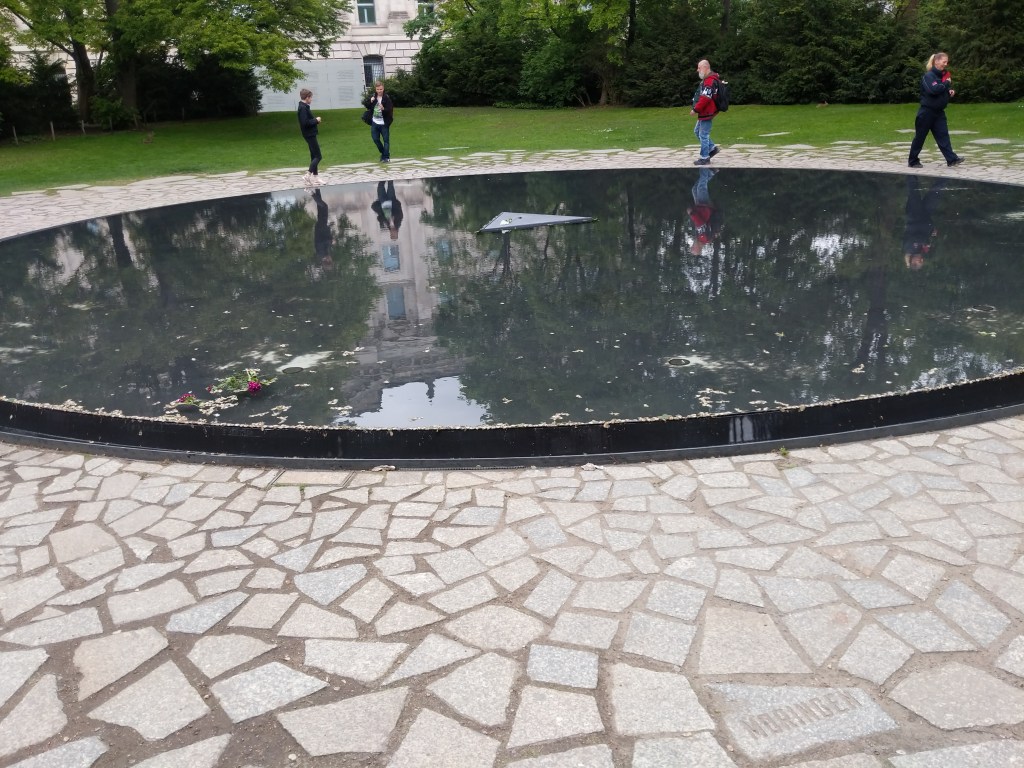
In the same garden I also came across another quiet memorial. This was the Memorial for the Sinti and Roma people, the gypsies of Europe. These interesting community have some obvious and distant connections to our own banjaras (gypsies of western India) and have always fascinated me, especially when I come across linguistic similarities. Here’s a video I watched a long ago, featuring a young Romani woman walking through the bazaars of Delhi.
Earlier in the day, the tour had taken us to yet another tragic memorial, the Memorial to the Murdered Jews of Europe, and that of course has to be one of the lasting scars in the history of the world. The memorial is a block of large granite stones that reminded me of tombs, hundred of them stretched out. A forest of darkness through which our tour-guide let us walk in silence. Afterwards, when we came out on the other side, we were asked to describe what we felt. That was a powerful experience that I think I should not put into words, and let it remain somewhere inside me.

In the course of visiting all these memorials, it struck me that each of these had been planned with deep thought. This ability to think through the objective of the memorial is in itself a testament of the respect shown to the dead. These memorials were built to evoke emotions, context and experience in us who come many years after these tragic deaths. Needless to say, I am simply blown by the scope and scale of such acts of remembrance, especially the individual efforts, like the stolperstein.
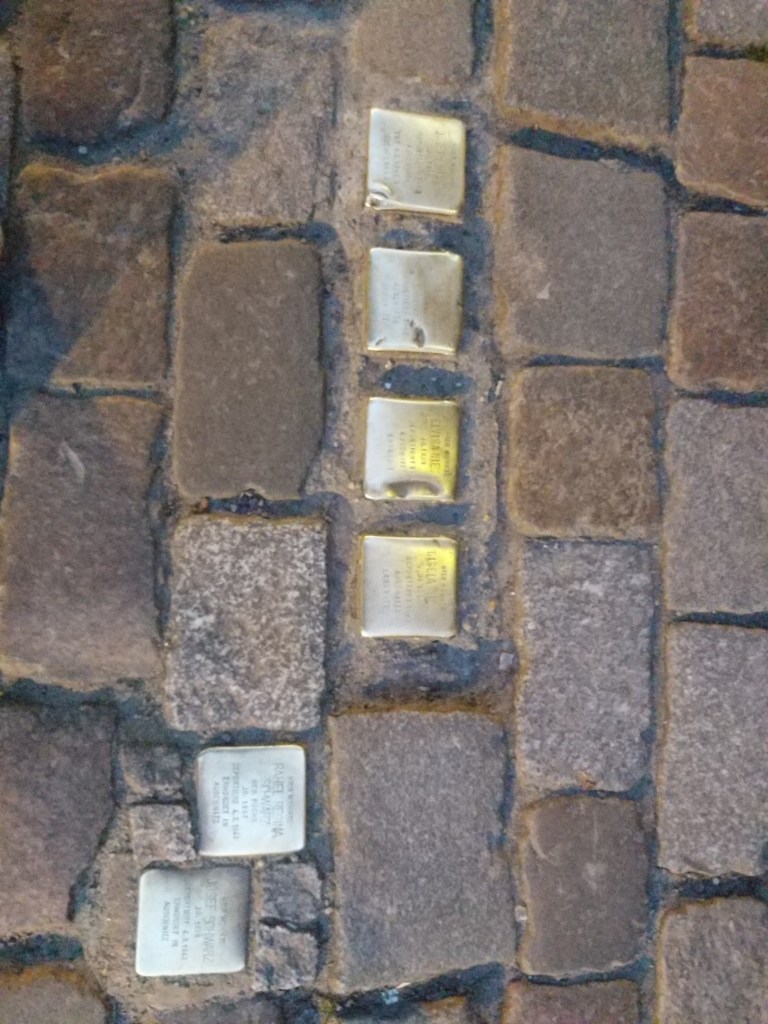
On one of my night-outs (with another desi that I met), I inadvertently found myself standing next to a set of stolperstein. I had spent days looking down while walking, looking out for these little bronze plaques and never coming across one; and yet, here I was, looking for some dinky club, stopping to take a breath..and right at my feet were these bronze embellishments. The stolperstein are the work of a German artist Gunter Demnig. Each hand-made plaque bears the name of a Jewish resident of the town. The stones record the year and place of birth, as well as the final destination… in all cases, the death camps. Local communities are actively involved in researching the names of the Jewish residents and an application is made to produce the little plaques. A few months later, these are lovingly set into the pavement, outside the homes and old offices of the victims.
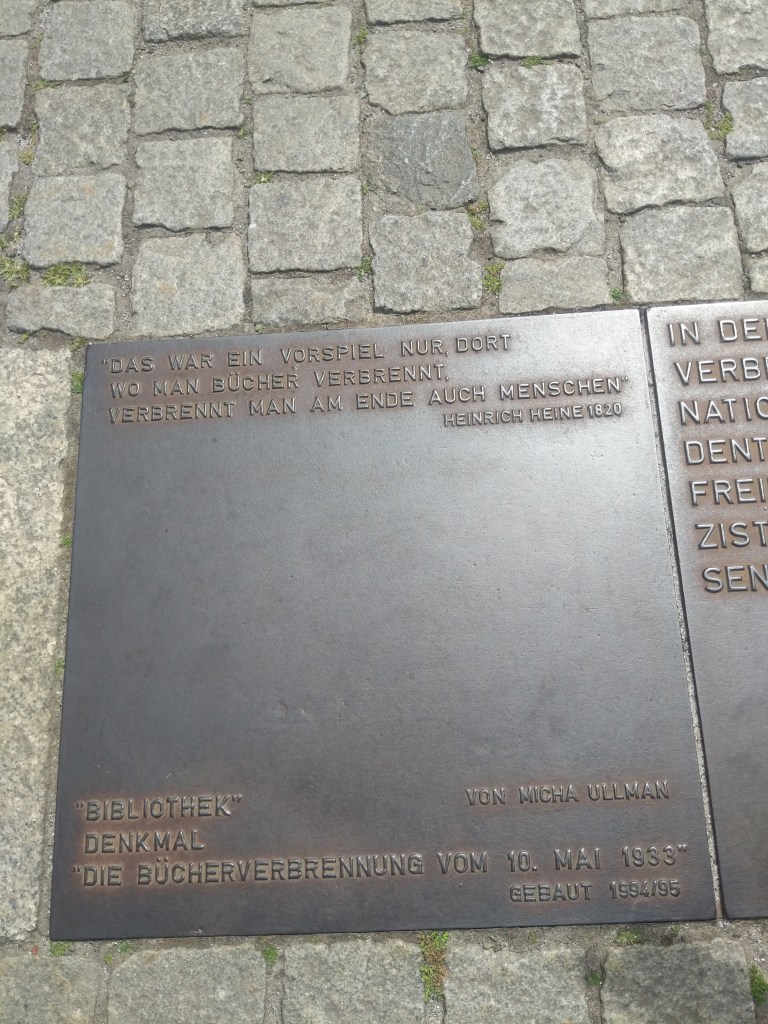
Finally, as a book lover and also a product of a most open education, I remember the plaza where the Nazis had a massive book burning. The irony is that these “ultra nationalists” destroyed potent symbols of knowledge right in front of the Humboldt University, in a square that is flanked by buildings from Germany’s own enlightened past.
This is the irony or perhaps the truth of the far-right ideologues, often they have little sense of the true greatness of their cultures and instead they represent the most narrow (and violent) tendencies of the primal human. As I stood over the glass pane that now covers symbolically empty book-shelves, I was thinking of the countless acts of violence back in India, the various artists we have hounded out of the country, the voices that have been silenced, the youth that has been stifled. It is the curse of our human existence that we will always co-exist with the Cain of our species.
 My Little Travel Diary